Sloth Bear
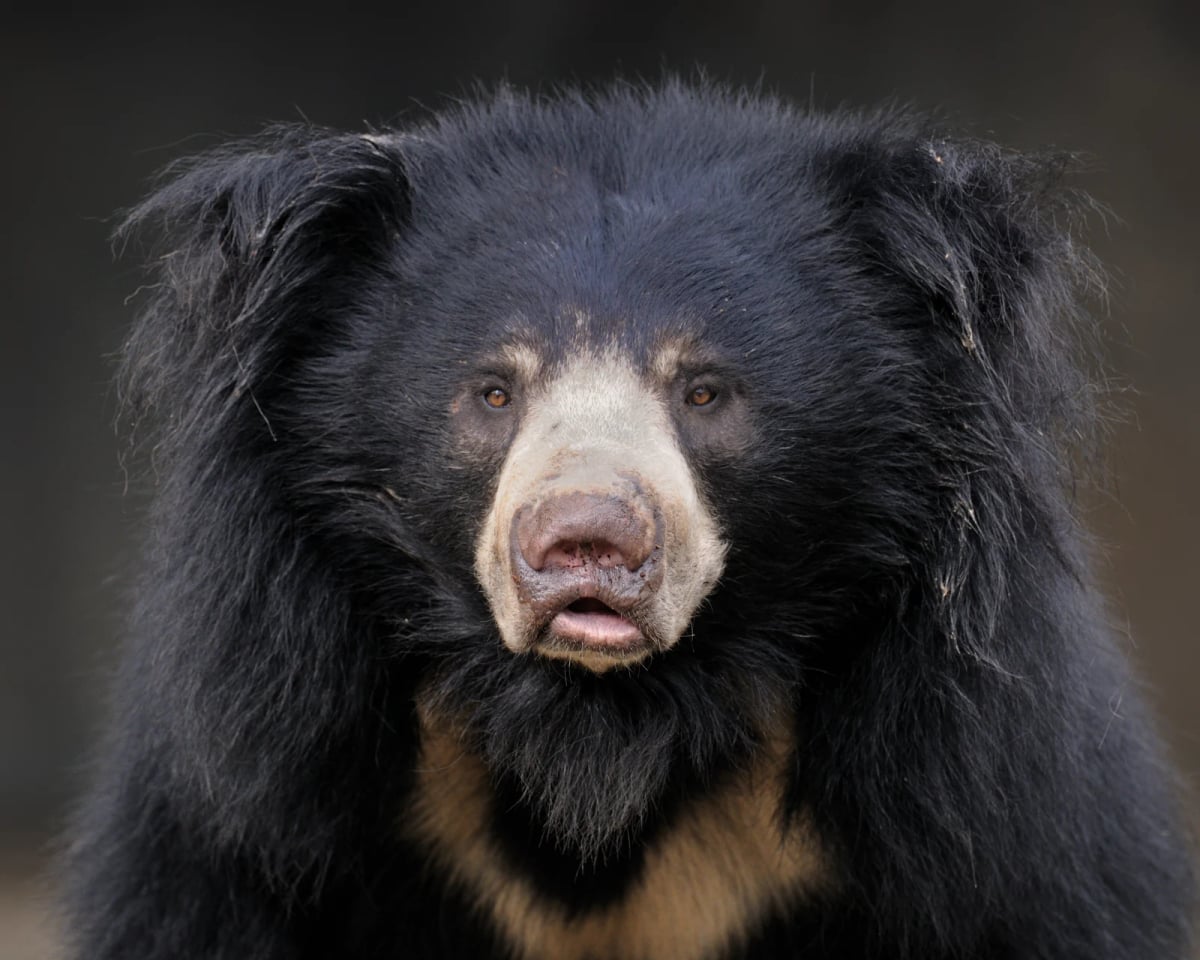
The sloth bear (Melursus ursinus) is a shaggy black bear of the Indian subcontinent, found in India, Sri Lanka and the lowlands of Nepal. It has a long, untidy coat, a pale, mobile snout, a white or cream V or Y shaped mark on the chest and long, curved claws up to about 8 centimeters. Despite its name, it is not related to the sloths of South America: early naturalists who saw its long claws and odd posture hanging from branches thought it was one. The sloth bear is the most specialized insect eater of all bears. It rips open termite mounds and ant nests with its claws, closes its nostrils, blows away the dust and sucks the insects up through a gap in its front teeth, making a noise that can be heard far away. It also eats large amounts of fruit, flowers and honey. Females carry their cubs on their backs, something no other bear does. Sloth bears live in dry and moist forests, scrub and grasslands, often near villages, and they are known for defending themselves fiercely when surprised, which makes them one of the bears that injure most people. For centuries they were also captured as cubs for the cruel dancing bear trade, which ended in India around 2009. The IUCN lists the species as Vulnerable, with a decreasing population.
What is a sloth bear?
The sloth bear is one of the eight living species of bears and the only one adapted mainly to eating termites and ants. Its scientific name is Melursus ursinus, roughly meaning bear like honey bear, and it lives only on the Indian subcontinent, in India, Sri Lanka and Nepal. The name sloth bear comes from a mistake. When European naturalists first saw specimens in the late 1700s, the long, curved claws and the habit of hanging upside down from branches convinced them that it was a kind of sloth, and it was even described as the bear sloth before scientists realized it was a true bear. The name stuck. Within the bear family, its closest relatives are the sun bear of Southeast Asia and the Asiatic black bear, and all three share a pale chest mark. The sloth bear is famous in India for several reasons: its loud, slurping way of feeding on termites, its habit of carrying cubs on its back and its reputation as a dangerous animal for villagers. It is also the bear behind Baloo in Rudyard Kipling's The Jungle Book, set in the forests of central India, although the cartoon version looks more like a gray bear.
How big is a sloth bear?
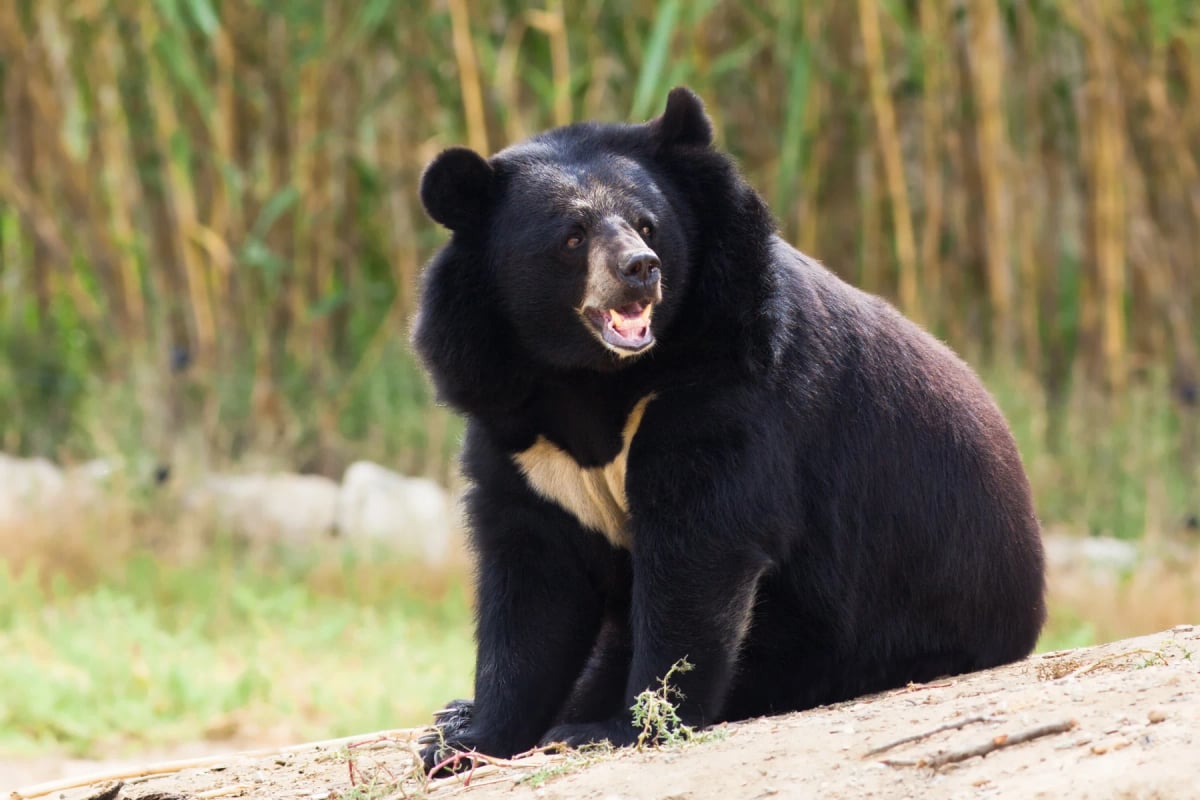
The sloth bear is a medium sized bear. Adults measure about 1.4 to 1.9 meters from nose to tail and stand 60 to 90 centimeters at the shoulder. Males are clearly bigger than females, usually weighing 80 to 145 kilograms, with the largest close to 190 kilograms, while females weigh about 55 to 95 kilograms. Bears in Sri Lanka tend to be a little smaller. Its body looks bigger than it is because of its long, shaggy black coat, which is longest on the shoulders and neck and forms a kind of mane. Unlike most bears, the sloth bear has almost no underfur, which suits the hot climate it lives in. On the chest it usually has a white, cream or yellowish mark shaped like a V, a U or a Y. The muzzle is long, pale and almost bare, with lips that it can push out into a tube, and the nostrils can be closed completely. Its feet are large, with long, curved, ivory colored claws on the front paws, up to about 8 centimeters long, ideal for digging into hard termite mounds. The sloth bear is also missing the two inner upper front teeth, which leaves a gap that works like a straw when it sucks up insects.
What do sloth bears eat?
Sloth bears are omnivores, but they rely on two main foods: insects and fruit. Termites and ants are eaten all year, and in the dry season, when little fruit is available, they can make up almost the entire diet. To reach them, the bear tears open hard termite mounds and rotting logs with its long claws, pushes its snout into the hole, closes its nostrils to keep out dust, blows away the loose soil and then sucks the insects up with powerful breaths through the gap in its front teeth. The huffing and slurping can be heard more than 100 meters away and is one of the best ways to know a sloth bear is near. When fruit is in season, sloth bears switch to it: they eat the fruit of jujube, figs, jackfruit, mango, ebony and many other trees, and the sweet flowers of the mahua tree, which they love. They are good climbers and also raid bee nests for honey and larvae, which is part of why they were once called honey bears. They occasionally eat eggs, carrion and crops such as maize and sugarcane, which can bring them into conflict with farmers. Sloth bears help the forest by spreading the seeds of the fruits they eat.
Are sloth bears dangerous?
Yes, sloth bears can be very dangerous, although they do not hunt people. In India they injure more people than tigers or leopards in many areas, and they are often considered among the most dangerous bears in the world for the number of attacks. The reason is mostly defensive. Sloth bears have poor eyesight and hearing, and while they are digging for termites or eating fruit they can be surprised by someone who comes very close before either notices the other. Instead of running away, a startled sloth bear often charges, rears up on its hind legs and strikes at the face and head with its long claws and teeth. Mothers with cubs are especially defensive. Most attacks happen at dawn and dusk to villagers collecting firewood, mahua flowers or other forest products, to farmers guarding crops and to people walking along forest paths, especially in states such as Madhya Pradesh, Chhattisgarh, Odisha and Jharkhand. Injuries can be severe, and some attacks are fatal. To reduce the risk, people in sloth bear areas are advised to walk in groups, make noise, carry a light at dawn and dusk and avoid dense thickets and termite mounds, and some villages use early warning systems and community programs.
Sloth bear cubs ride on their mother's back
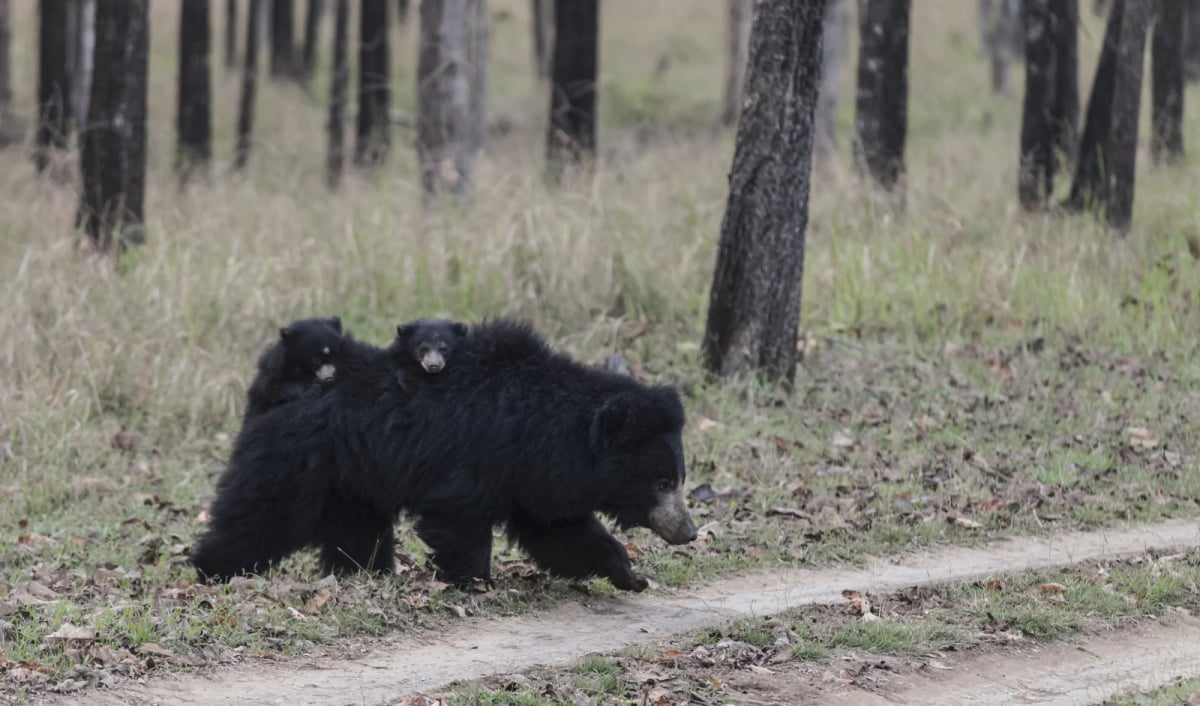
Sloth bears are the only bears that regularly carry their cubs on their backs. Mating usually takes place in the hot months, and after a pregnancy of about six to seven months, which includes a delay before the embryo implants, the female gives birth in a den, often a cave, a hollow under rocks or a dug burrow. Births usually happen in the cooler months, around December and January in India. Most litters have one or two cubs, rarely three. The cubs are born blind and helpless and stay in the den for the first two to three months. Once they leave it, they ride on their mother's back, clinging to her long, shaggy fur, and they keep riding there for much of their first year, until they are about a third of her size. When danger appears, the cubs climb onto her back instead of running up a tree, and the mother faces the threat or runs off with them, which may be an adaptation to predators such as tigers and leopards, which can also climb. The cubs stay with their mother for two to three years, learning where to find termites, fruit and water, before they set out on their own. Sloth bears can live about 20 years in the wild.
Where do sloth bears live?
Sloth bears live only on the Indian subcontinent. India holds by far the largest population, spread across much of the country, especially the forests of central India, the Western and Eastern Ghats, the Deccan Plateau and the foothills of the Himalayas. In Nepal they live in the lowland Terai along the border with India, in parks such as Chitwan, Bardia and Parsa. Sri Lanka has its own subspecies in the dry lowland forests of the north and east. The species has disappeared from Bangladesh, and its presence in Bhutan is uncertain. Sloth bears use a wide range of habitats, from dry deciduous forest and thorny scrub to moist forest, grasslands and rocky hills with caves, usually below about 1,500 meters and occasionally up to 2,000 meters. What they need most are termite mounds, fruiting trees, water and safe places to rest during the day, such as caves, rock crevices and dense thickets. Many live outside protected areas, in forests and scrubland close to villages and farmland, which is why encounters with people are so common. Good places to see them include Daroji Sloth Bear Sanctuary in Karnataka, Satpura, Tadoba, Kanha and Ranthambore in India, Chitwan in Nepal and Yala and Wilpattu in Sri Lanka.
The Sri Lankan sloth bear
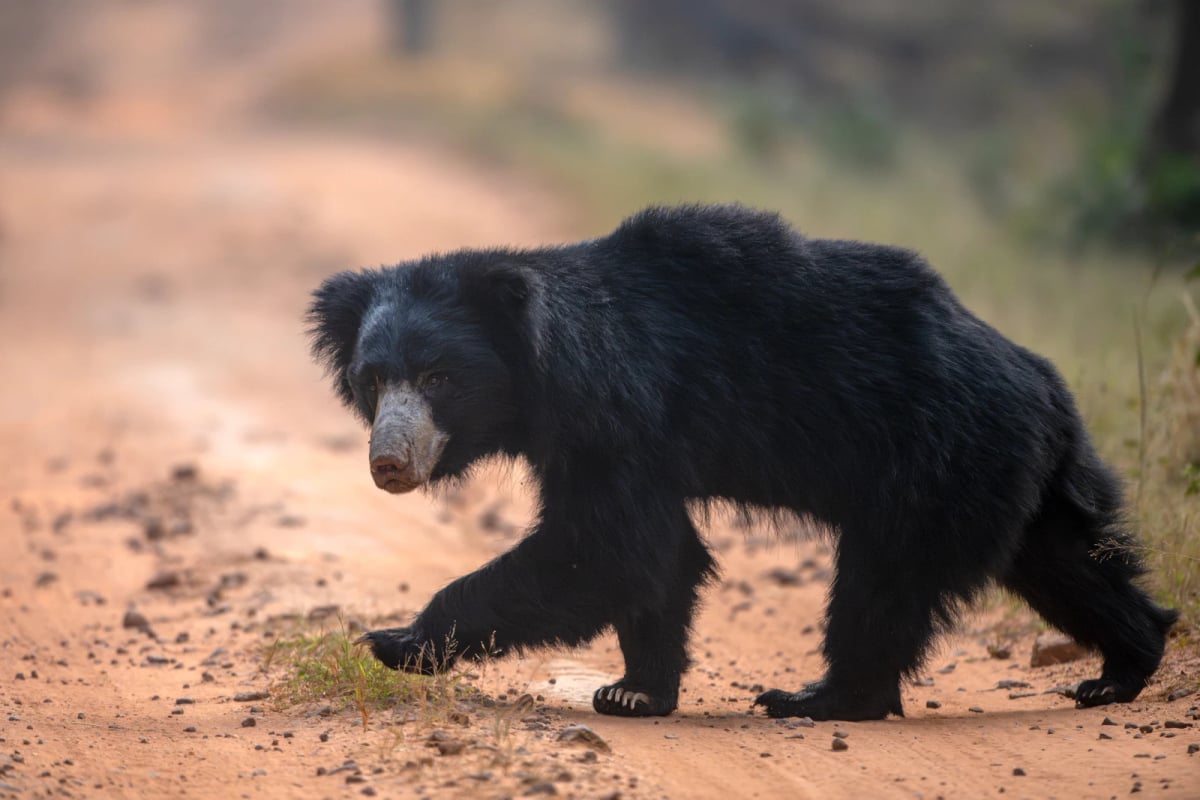
Scientists recognize two subspecies of sloth bear. The Indian sloth bear, Melursus ursinus ursinus, lives in India and Nepal, and the Sri Lankan sloth bear, Melursus ursinus inornatus, lives only in Sri Lanka. The island bears are a little smaller, with shorter, thinner fur, and the chest mark is often small or missing, which is what the name inornatus, meaning unadorned, refers to. Sri Lankan sloth bears live mainly in the dry zone of the north, east and southeast of the island, in monsoon forest and scrub, and studies suggest that they occupy less than a fifth of the country, with much of their range inside national parks and strict reserves. Yala National Park in the southeast and Wilpattu National Park in the northwest are the best places to see them, especially from May to July, when the palu trees fruit and bears come out in daylight to feed on the sweet berries. In Sri Lanka, the sloth bear shares its forests with leopards and Asian elephants, and it has a strong reputation among villagers, who fear its sudden attacks when they collect forest products. The Sri Lankan population is small and isolated, so loss of forest is a particular concern there.
The end of India's dancing bears
For centuries, sloth bears were the main victims of the dancing bear trade in South Asia. Members of the Kalandar community, who traditionally made their living as street entertainers, bought cubs taken from the wild, often after their mothers were killed by poachers. The cubs' muzzles were pierced with a hot iron rod to pass a rope through, their teeth were knocked out and their claws cut, and they were trained with pain to stand and sway on their hind legs to music for tourists along highways and in towns. Thousands of bears lived this way, and the practice also drove the capture of wild cubs. Dancing bears were banned under India's Wildlife Protection Act of 1972, but the trade continued for decades. In the 1990s and 2000s, the organizations Wildlife SOS, International Animal Rescue and Free the Bears worked with the Indian government to rescue the bears and help the Kalandar families find other jobs, with training, small loans and schooling for their children. More than 600 bears were rescued and moved to sanctuaries such as the Agra Bear Rescue Facility and the Bannerghatta Bear Rescue Centre. In December 2009, a bear named Raju was rescued as the last known dancing bear in India.
Is the sloth bear endangered?
The sloth bear is not listed as Endangered, but the IUCN classifies it as Vulnerable, with a decreasing population, in its 2016 assessment. Estimates of how many remain vary a lot, from about 10,000 to 20,000 in total, most of them in India, with fewer than 1,000 in Nepal and a small, isolated population in Sri Lanka. The main threat is the loss and fragmentation of its forests to farming, roads, mining and growing villages, which also pushes bears and people closer together. Conflict is a serious problem: after attacks on people or damage to crops, bears are sometimes killed in revenge, and many die in snares set for other animals. Poaching for gall bladders and other body parts, used in traditional medicine, also continues in some areas, and the capture of cubs for the dancing bear trade once took a heavy toll. In India the sloth bear is protected under Schedule I of the Wildlife Protection Act, the highest level of protection, and it lives in many tiger reserves and sanctuaries. Researchers are radio collaring bears to understand their movements, and community programs teach villagers how to avoid encounters, which is key to the bear's future.