Snowy Owl
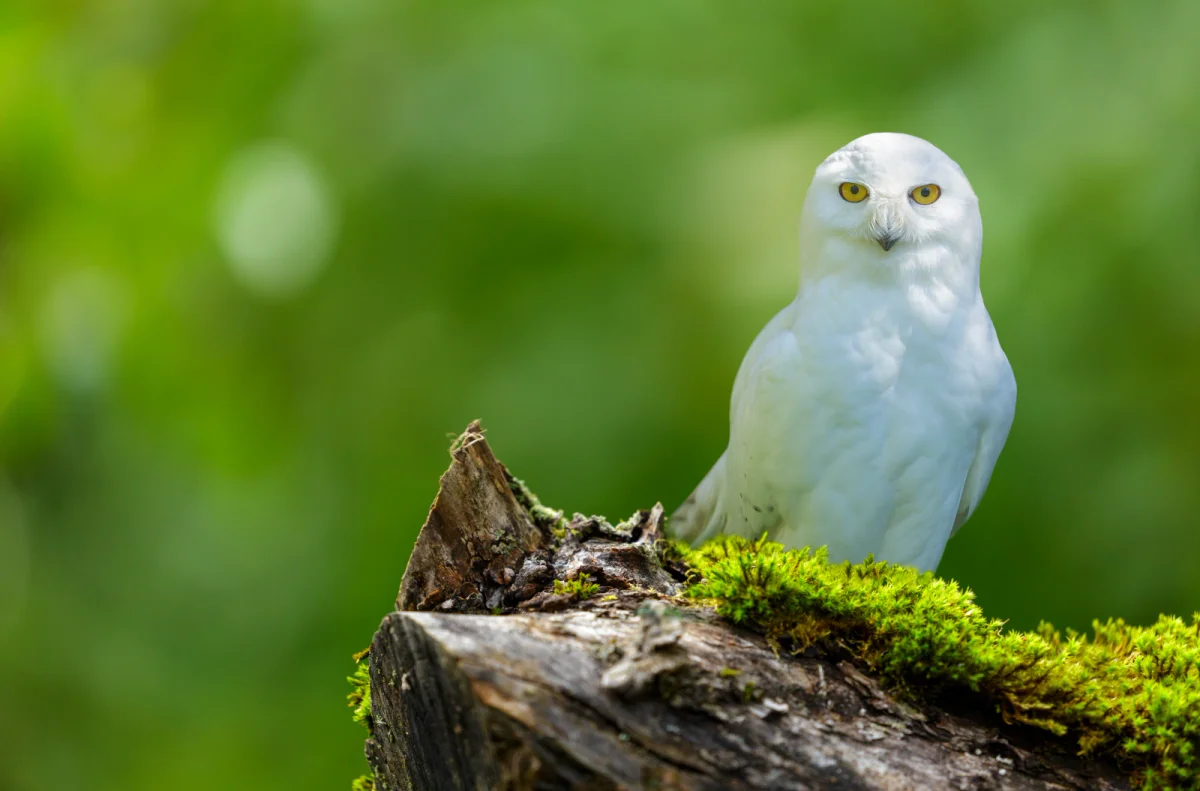
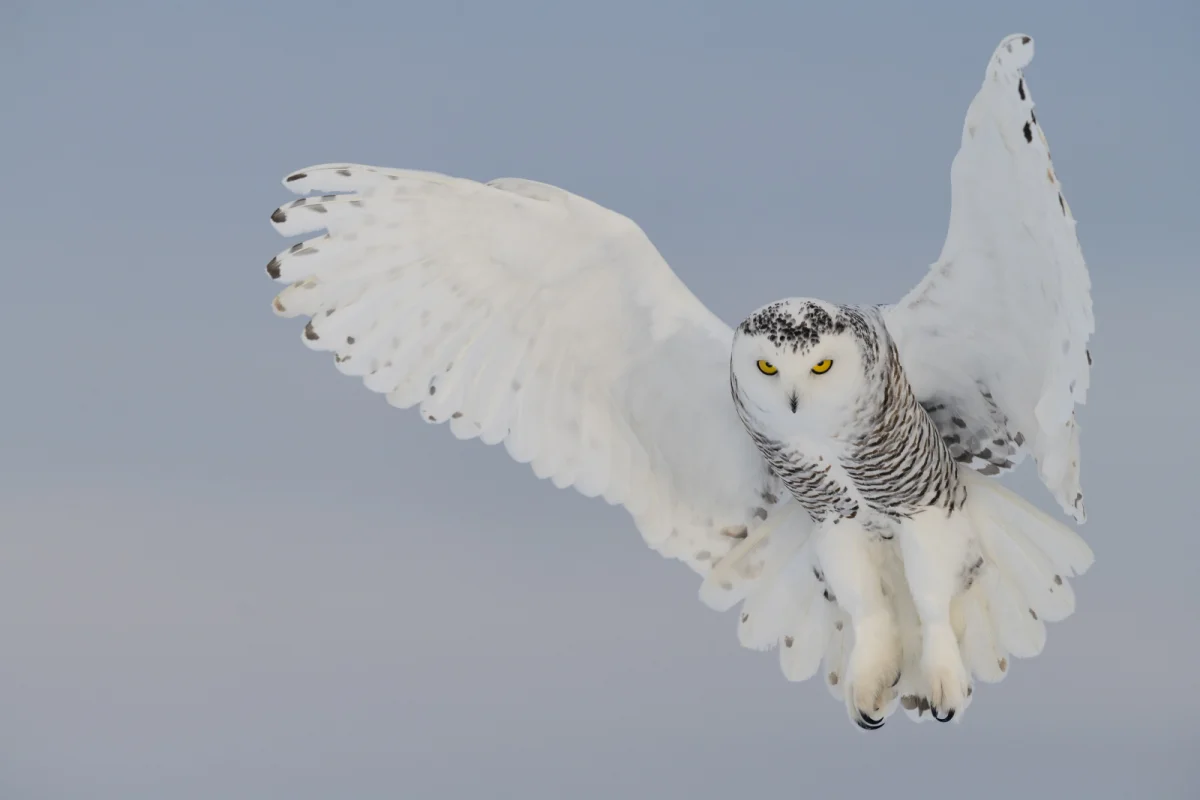
The snowy owl (Bubo scandiacus) is a large white owl of the Arctic tundra and the heaviest owl in North America. Adult males can be almost pure white, while females and young birds are white with dark brown bars and spots, a pattern that helps them hide on nests among snow patches and lichens. It has bright yellow eyes, a round head with tiny ear tufts that are rarely visible and thick feathers covering its legs and toes against the cold. Unlike most owls, it hunts by day as well as at night, which makes sense in a place where the sun does not set in summer. Its main prey is lemmings, and the number of owls that breed in an area, and the number of eggs they lay, rise and fall with lemming numbers. It breeds across the tundra of Alaska, northern Canada, Greenland, northern Scandinavia and Russia, nesting on the ground on small mounds. In winter many move south to open country such as prairies, farmland, coasts, marshes and even airports, and in some years large numbers reach far beyond their usual range in events called irruptions. The IUCN lists the snowy owl as Vulnerable, with roughly 14,000 to 28,000 adults and a decreasing population.
What is a snowy owl?
The snowy owl is a large white owl that breeds on the treeless Arctic tundra of North America, Greenland, Europe and Asia. Many people know it simply as the white owl, the great white owl, the arctic owl or the polar owl, and all of those names usually refer to this species, the only owl in the world that is mostly white. Its scientific name is Bubo scandiacus. For a long time it was placed in its own genus, Nyctea, but DNA studies showed that it is closely related to the eagle owls and the great horned owl, so it was moved into the genus Bubo. The species name scandiacus means from Scandinavia, where it was first described for science in the 1700s. Snowy owls are built for one of the harshest places on Earth. They are heavy and thickly feathered, they hunt by day as well as at night and they can live on lemmings for months. Their lives follow the boom and bust cycles of those small rodents: in good lemming years they raise large families, and in poor years many do not breed at all. In winter some stay in the Arctic, while others move south and appear on beaches, fields and airports far from the tundra, which is when most people get to see one.
How big is a snowy owl?
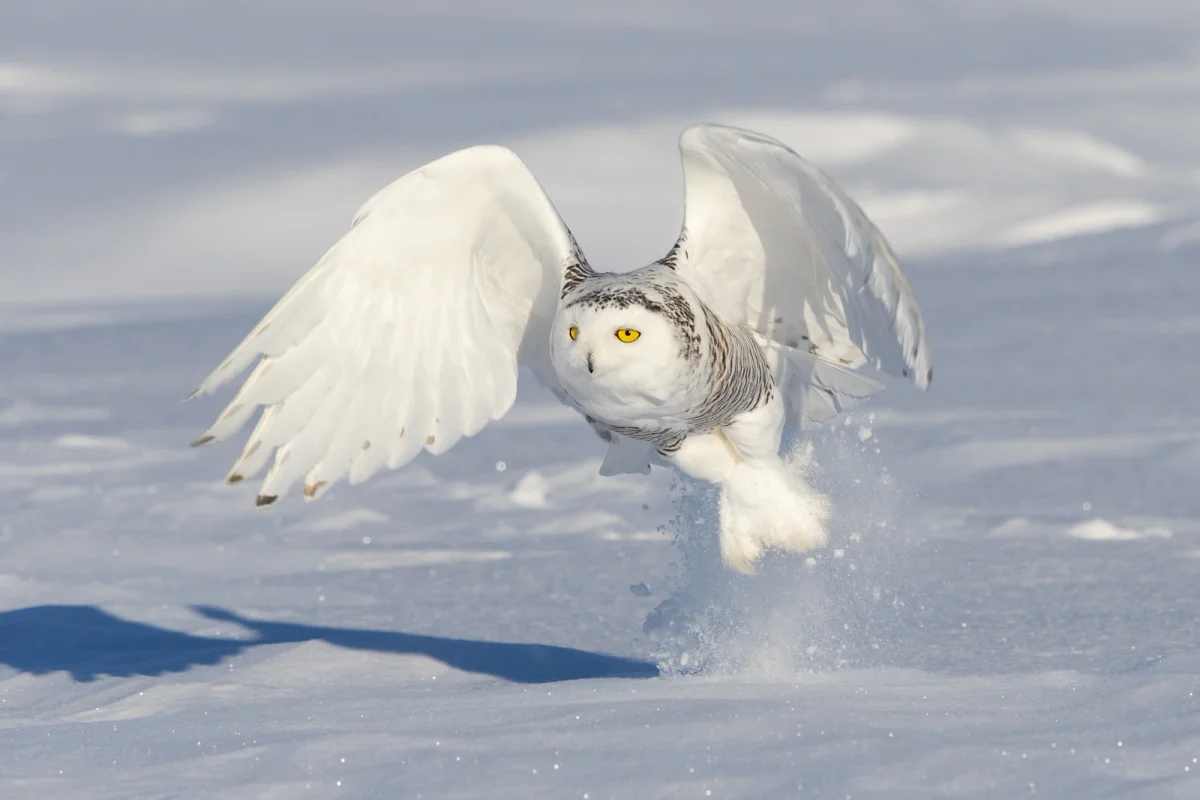
The snowy owl is one of the biggest owls in the world and the heaviest owl in North America. It measures about 52 to 71 centimeters from head to tail, and its wings span 125 to 150 centimeters. Weight is what sets it apart: adults usually weigh between 1.6 and 3 kilograms, with females clearly heavier than males, as in most birds of prey. Much of that bulk comes from a thick layer of feathers and, in good times, a reserve of fat. The head is round and smooth, with two tiny ear tufts that the owl can raise but that are rarely visible. The eyes are large and bright yellow, and the black bill is so hidden among feathers that only its tip shows. The legs and toes are covered in long, dense feathers, which make the feet look like furry slippers and leave only the black claws exposed. In flight, the snowy owl looks broad winged and powerful, with steady, shallow wingbeats close to the ground, more like a hawk than a typical owl. On the ground it often perches on low mounds, rocks, fence posts or dunes, sitting still for hours while it watches for prey.
Male vs female snowy owl
Male and female snowy owls look clearly different, which is unusual among owls. Adult males are the whitest. Young males have some dark bars, but they lose most of them as they age, and old males can be almost pure white, with only a few small spots on the wings and head. Females are larger and much more heavily marked, with dark brown bars across the chest, back and wings, and only the face, throat and feet remain clean white. Young birds of both sexes look like females in their first year, and young females are the darkest of all, so a heavily barred snowy owl seen in winter is usually a female or a juvenile. The difference has a purpose. The female does all the incubating and spends weeks sitting on the nest on open tundra, where her barred plumage blends with patches of snow, rock, lichen and dead grass and helps hide her from arctic foxes, skuas and gulls. The male hunts and brings food, and his white plumage may help him blend with snow and sky, or simply show off his quality to females. Telling the sexes apart is not always easy, though, because individuals vary and some heavily marked males look a lot like pale females.
Snowy owl vs barn owl and other white owls
The snowy owl is the only owl that is mostly white all over, but it is often confused with the barn owl, which also looks pale. The two are easy to tell apart. The barn owl is much smaller and lighter, usually weighing only 250 to 500 grams, and it has a heart shaped white face, dark eyes and golden buff and gray feathers on its back and wings. Only its face and underparts are white. It is mainly nocturnal, lives in farmland, grassland and old buildings on almost every continent and would never survive an Arctic winter. The snowy owl is several times heavier, has a round head, yellow eyes and white feathers over its whole body, including the feet, and hunts in daylight on open ground. Searches for an albino owl usually come from photos of snowy owls or of barn owls in flight. True albino owls, with no pigment at all and pink or red eyes, are extremely rare, and leucistic owls, which are pale but keep dark eyes, are rare as well. The snowy owl is neither: it is white by nature, its eyes are yellow and its plumage, especially in females and young birds, carries dark markings that albino birds lack.
Feathered feet and other adaptations to the cold
Everything about the snowy owl helps it survive temperatures that can fall below minus 40 degrees. Its plumage is unusually thick and dense, and it is one of the heaviest owls for its length because of the extra layers of feathers. The legs and toes are covered with long, soft feathers, which protect them from frostbite and work like insulated boots when the owl stands on snow or ice. Even the bill is mostly hidden by feathers, and the nostrils are covered too, which reduces the loss of heat. The white color helps with camouflage in snow, both when hunting and when hiding from predators. Its hearing is excellent, as in other owls, and it can locate lemmings moving in tunnels under the snow, then plunge its feet through the crust to grab them. Its eyes are large and sharp in bright light as well as in the dim Arctic winter, which allows it to hunt around the clock in the long days of summer. Its body can also store fat, which helps it get through storms and stretches with little food. Satellite tracking has shown that some snowy owls spend the whole winter far out on the frozen Arctic sea, hunting seabirds such as eiders at openings in the ice.
Where do snowy owls live?
Snowy owls breed on the open Arctic tundra all around the North Pole: in northern and western Alaska, across the Canadian Arctic from the Yukon to Nunavut, northern Quebec and Labrador, in northern and eastern Greenland, in the mountains and tundra of northern Norway, Sweden and Finland and along the whole Arctic coast of Russia, from the Kola Peninsula to Chukotka and Wrangel Island. They prefer flat or gently rolling tundra with small hills and mounds where they can nest and watch for prey, usually below about 1,500 meters. Where exactly they breed changes from year to year, because the owls move long distances to find areas where lemmings are abundant, and in many places they breed only in peak lemming years. In winter, snowy owls spread out. Some stay far north, even on the sea ice, while others move south to open landscapes that look a little like tundra: the prairies and farmland of southern Canada and the northern United States, the shores of the Great Lakes, Atlantic beaches and dunes from the Maritimes to New York, and airports, whose wide, flat grasslands attract them. In Eurasia they winter on the steppes of southern Russia and Kazakhstan, and a few reach northern China and Japan.
What do snowy owls eat?
In the breeding season, snowy owls depend on lemmings, small round rodents of the tundra. An adult eats several lemmings a day, and one owl may eat more than 1,600 in a year. A family with a large brood needs far more, so the owls only breed where lemmings are plentiful. Lemming numbers rise and crash in cycles of about three to five years, and the owls follow them across the Arctic. When lemmings are scarce, snowy owls switch to other prey: voles, Arctic hares, ptarmigan, ducks, geese, gulls and other seabirds, and even fish and carrion. In winter, their diet depends on where they are. Owls on the prairies and farmland catch voles, mice, rabbits and birds such as partridges, while those on the coasts hunt ducks, grebes, gulls and shorebirds, and owls that spend the winter on the sea ice catch eiders and other seabirds at open water. Snowy owls usually hunt by sitting and waiting on a low perch, then flying low over the ground to grab prey with their feet. They can also catch birds in flight and snatch prey from the surface of the water. Small prey is swallowed whole, and the bones, fur and feathers are later coughed up as pellets.
Snowy owl migration and irruptions
Snowy owls are nomads more than regular migrants. Every autumn many leave the high Arctic and move south, but how far they go and how many come varies enormously from year to year. Some winters only a few appear in southern Canada and the northern United States. In others, called irruption years, thousands flood south, reaching the Atlantic coast, the Great Lakes and the prairies in large numbers, and a few wander as far as Bermuda and the southern states. Irruptions were long thought to happen when owls starved after a lemming crash. Research has shown the opposite: they usually follow a very good breeding summer, when lots of young owls were raised and many of them, especially young birds, disperse south to find their own winter territory. The winter of 2013 to 2014 brought one of the biggest irruptions on record in eastern North America, and it led to Project SNOWstorm, which fits snowy owls with tracking devices. Those trackers have shown that individual owls can travel thousands of kilometers, that some spend weeks on frozen lakes or sea ice and that many return north in spring to completely different areas of the Arctic. Winter owls are often seen on beaches such as those of Cape Cod and Long Island.
Snowy owl nests and chicks
Snowy owls nest on the ground, usually on top of a small mound, hummock or ridge with a good view of the surrounding tundra. The female scrapes a shallow bowl in the soil and lays her eggs directly in it, without building a real nest. The number of eggs depends on food. In poor years a pair may lay three or four eggs or not breed at all, while in years with plenty of lemmings a female can lay 7 to 11, and occasionally more. She lays them about two days apart and starts incubating with the first egg, so the chicks hatch one by one over two or three weeks, after about 32 days of incubation each. The oldest chick can be much bigger than the youngest, and if food runs short the smallest ones die. The female stays on the nest while the male hunts and brings lemmings, sometimes piling extra food around the nest. Chicks are covered in gray down and leave the nest on foot at about three weeks old, before they can fly, spreading out among the hummocks while both parents keep feeding them. They fly at around seven weeks. Snowy owls defend their nests fiercely, diving at arctic foxes, wolves, skuas and even people, and some geese nest close to them for protection.
Are snowy owls endangered?
The snowy owl is not endangered, but it is listed as Vulnerable by the IUCN, one step below. It was moved up from Least Concern in 2017, when new research showed that there are far fewer snowy owls than once believed. Earlier estimates spoke of 200,000 or more, but studies of how the owls move and how thinly they are spread across the Arctic suggest only about 14,000 to 28,000 adults worldwide. Monitoring in North America also points to steep declines over recent decades, and numbers in northern Europe and Russia are probably falling as well. The causes are not fully understood. Climate change is a major concern, because warmer, wetter winters can disrupt the lemming cycles the owls depend on, and the tundra itself is changing as shrubs spread north. In winter, snowy owls are often killed by collisions with cars, power lines and aircraft, since they like open spaces such as roadsides and airports. Some are poisoned by rodenticides or lead, and avian influenza has killed others. In the past, many were shot as trophies or for food, and some are still hunted in parts of the Arctic. Today most airports in North America trap and move snowy owls instead of killing them.
Where it is found
The Snowy Owl can be found in places such as: