Bearded Vulture
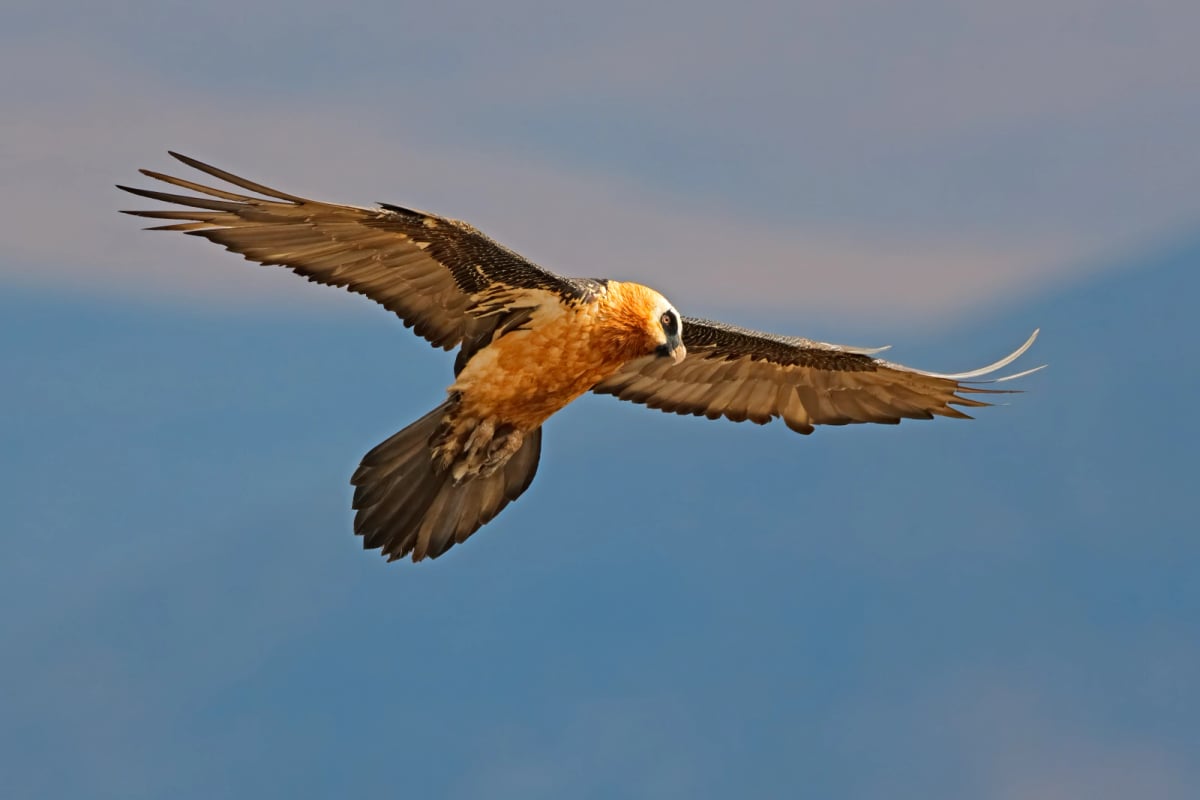
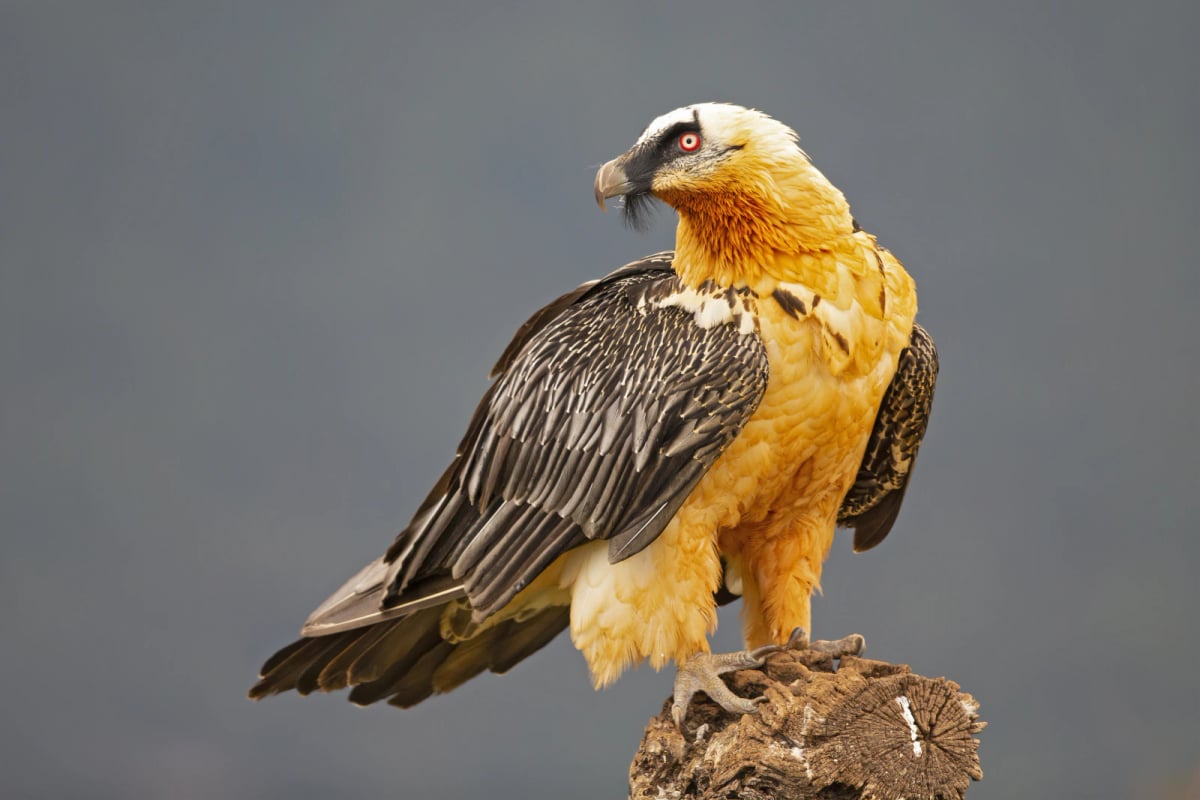
The bearded vulture (Gypaetus barbatus), also known as the lammergeier, is a huge vulture of the high mountains of Europe, Asia and Africa and the only bird in the world that lives almost entirely on bones. It has a wingspan of about 2.3 to 2.8 meters, long, narrow wings and a long, wedge shaped tail, so in flight it looks more like a giant falcon than a typical vulture. Unlike most vultures, its head is fully feathered, with a black mask around the eyes, a bright red ring around each eye and a tuft of black bristles under the bill that gives the bird its name. Adults have dark gray wings and back and a white body that the birds dye a rusty orange by bathing in mud and dust rich in iron oxide. Bones make up about 70 to 90 percent of what it eats. It swallows smaller bones whole, and carries larger ones into the air and drops them onto rocks to break them into pieces it can swallow; very strong stomach acid then digests them. Bearded vultures live in pairs that defend large territories among cliffs and gorges, often above 1,000 meters and up to about 7,500 meters in the Himalaya. They disappeared from much of Europe in the nineteenth and twentieth centuries, but reintroduction projects have brought them back to the Alps and other mountains. The IUCN lists the bearded vulture as Near Threatened, because its numbers are falling across much of Asia and Africa, mainly from poisoning, collisions with power lines and the loss of wild and domestic carcasses.
Bearded Vulture or Lammergeier: Names and Family
The bearded vulture goes by several names, and most of them come from its looks or its unusual diet. Bearded vulture refers to the tuft of stiff black bristles that hangs below the bill like a small beard. Lammergeier comes from the German Lämmergeier, which means lamb vulture, a name born from the old and false belief that these birds carried off lambs. In Spanish it is called quebrantahuesos, the bone breaker, and an old English name, ossifrage, comes from Latin and means the same thing. Its scientific name, Gypaetus barbatus, mixes the Greek words for vulture and eagle with the Latin word for bearded, a good summary of a bird that looks halfway between the two. The bearded vulture belongs to the hawk and eagle family, Accipitridae, and to the group known as Old World vultures, but it has no close relatives among the big griffon vultures. Its nearest relatives are the much smaller Egyptian vulture and the palm nut vulture of Africa. Scientists usually recognize two subspecies: Gypaetus barbatus barbatus, which lives in Europe, North Africa and Asia, and Gypaetus barbatus meridionalis, which lives in Ethiopia, East Africa and southern Africa and has a paler head and no black band across the chest. An old Greek story says that the playwright Aeschylus died when a bird dropped a tortoise on his head. If the story is true, the bird may well have been a bearded vulture, since it also breaks tortoises by dropping them onto rocks.
Bearded Vulture Size and Appearance
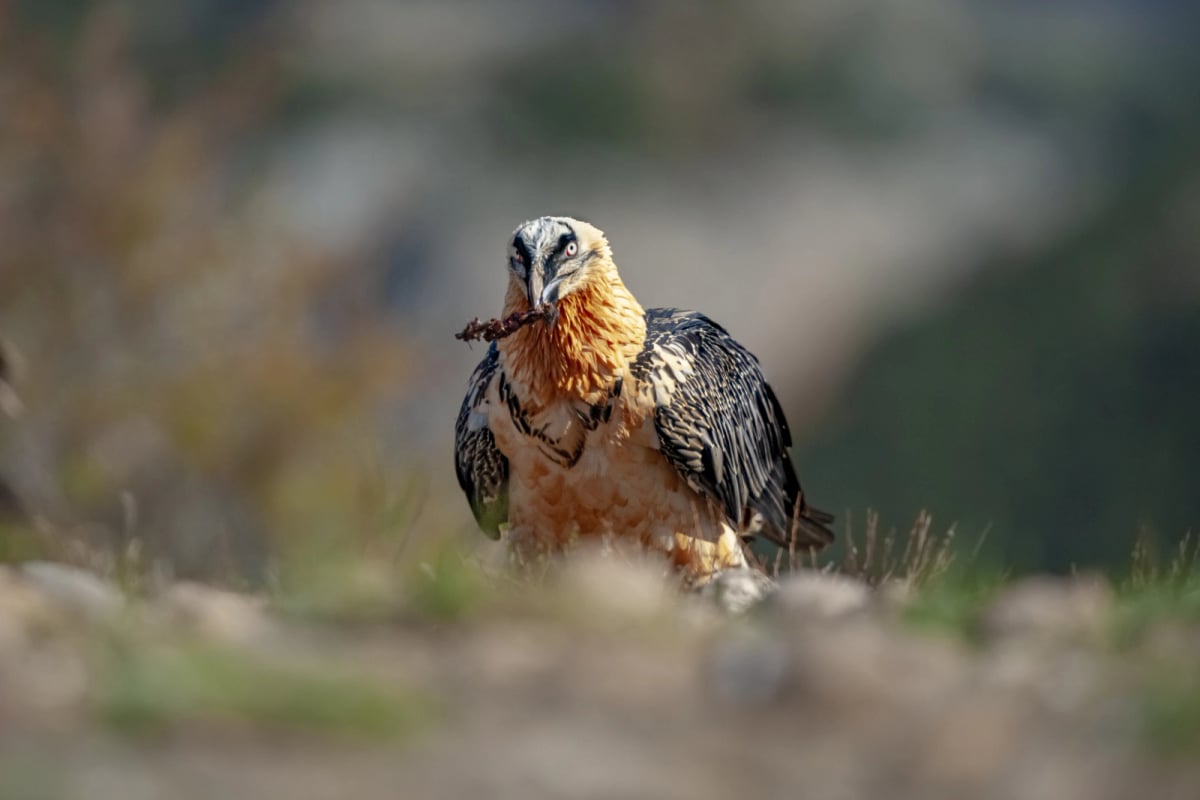
The bearded vulture is one of the largest birds of prey in the Old World. Adults measure about 94 to 125 centimeters from bill to tail, have a wingspan of about 2.3 to 2.8 meters and weigh about 4.5 to 7.8 kilograms, with females slightly larger than males. That makes it lighter than a griffon vulture of similar wingspan, and its build is very different: the wings are long and pointed, and the tail is long and shaped like a diamond or a wedge, so a soaring bearded vulture is easy to tell apart from the broad winged griffons that share its mountains. The head is covered in feathers, which is rare among vultures, because it does not push its head into rotting carcasses. Adults have a cream or white head, a black mask that runs from the eye to the bill, a tuft of black bristles under the bill and pale yellow eyes ringed in bright red. That red ring, called the scleral ring, swells and becomes brighter when the bird is excited or feels threatened. The back, wings and tail are dark slate gray with fine pale streaks. The most striking feature is the color of the neck, chest and belly. Their feathers are naturally white, but wild adults look orange or rusty red because they bathe in springs and dust rich in iron oxide and rub the color into their plumage. Scientists still discuss why they do it; it may be a sign of status or a way to protect the feathers. Young birds are dark brown with a black head and take about six or seven years to reach adult colors.
Bearded Vulture Habitat and Range
The bearded vulture is a bird of high, open mountains. It needs steep cliffs and gorges with caves and ledges for nesting, open slopes, alpine meadows and rocky ground where it can find carcasses, and strong winds that let it glide for hours without flapping. It usually lives above 1,000 meters, and in the Himalaya it has been recorded at about 7,500 meters, close to the height of the highest peaks on Earth. Its range is huge but broken into separate mountain blocks. In Europe it lives in the Pyrenees of Spain and France, in the Alps of France, Italy, Austria and Switzerland, on Corsica and on Crete, with smaller reintroduced groups in other Spanish and French mountains. Farther east it lives in the mountains of Türkiye, the Caucasus of Georgia, Armenia, Azerbaijan and Russia, and the ranges of Iran and Afghanistan. Its largest stronghold is the great mountain belt of Central Asia: the Hindu Kush, Karakoram and Himalaya of Pakistan, India, Nepal, Bhutan and China, the Tibetan Plateau, the Pamir and Tian Shan of Tajikistan, Kyrgyzstan, Uzbekistan, Kazakhstan and Turkmenistan, and the Altai of Mongolia and Russia. In Africa, the largest population lives in the highlands of Ethiopia, and another, isolated group lives in the Maloti and Drakensberg mountains of Lesotho and South Africa. A few birds still survive in the High Atlas of Morocco and on the high volcanoes of East Africa, but those populations are now tiny. Bearded vultures do not migrate. Adults stay in their territories all year, while young birds can wander hundreds of kilometers before they settle down.
Diet and Bone Breaking
The bearded vulture is the only bird that lives almost entirely on bones. Bones and the marrow inside them make up about 70 to 90 percent of its diet, and the rest is meat, skin and other scraps from carcasses. It usually arrives after other scavengers such as griffon vultures, golden eagles, foxes and wolves have eaten the meat, so it has little competition for what is left. Its main sources are dead wild goats, ibex, chamois, sheep and other mountain animals, along with livestock that die in the high pastures. Bones are a very good food for a bird that can digest them. Marrow is rich in fat, bones keep for a long time without rotting, and few other animals want them. The bearded vulture can swallow bones whole up to the size of a lamb's thigh bone, and its stomach is extremely acidic, with a pH estimated at close to 1, so it can digest a large bone in about a day. Bones too big to swallow are broken. The bird carries a bone in its feet, rises to about 50 to 150 meters above a flat rocky area and lets it fall, then drops down to pick up the pieces. It often uses the same rocky slabs again and again, and young birds need years of practice to do it well. Bearded vultures break tortoises in the same way in some places, and occasionally take live prey such as small mammals or lizards, but they almost never kill large animals. The old idea that they carry off lambs, goats or even children is a myth.
Breeding and Chicks
Bearded vultures usually pair for life, and each pair defends a large territory that can cover several hundred square kilometers of mountains. Some territories are held by a trio, two males and a female, which then raise chicks together. A pair has several nests in its territory, built in caves or on sheltered ledges of high cliffs, and they reuse and add to them year after year until they become large piles of branches lined with wool, hair and dry grass. Unlike most birds of the northern mountains, bearded vultures breed in the middle of winter. In Europe the female lays her eggs between December and February, so that the chick hatches at the end of winter, when many animals have died from cold and hunger and there are plenty of carcasses and bones to feed it. She usually lays two eggs a few days apart, and both parents take turns sitting on them for about 53 to 58 days. Even when both eggs hatch, only one chick survives: the older one usually kills or starves its younger sibling in the first days, so the second egg works only as a spare. The chick stays in the nest for about 100 to 130 days, longer than almost any other bird of prey, and depends on its parents for several more months after its first flight. Young bearded vultures then wander widely and do not breed until they are about seven or eight years old, which is one reason the species recovers so slowly. In the wild they live about 20 years on average, and in captivity some have lived more than 45 years.
Bearded Vulture Population and Conservation Status
The IUCN lists the bearded vulture as Near Threatened, a category it has held since 2014, after decades as Least Concern. The latest assessment, made by BirdLife International in 2021, estimates the world population at about 2,500 to 10,000 birds, or roughly 1,675 to 6,700 adults, and says it is decreasing overall, although the trend changes a lot from one region to another. The main threat is poison. Bearded vultures die after eating carcasses laced with poison meant for wolves, jackals or other predators, and from lead in the remains of animals shot by hunters. They also die in collisions with power lines and wind turbines, and they suffer when there are fewer wild herds and less livestock dying in the mountains. In some places they are still shot or their body parts are used in traditional medicine. In southern Africa, the isolated population of the Maloti and Drakensberg has fallen to about 100 breeding pairs, and in East Africa only a handful of pairs may be left. Europe is the opposite story. Hunting and poisoning wiped the bearded vulture out of the Alps by the early twentieth century, and it vanished from most of southern Europe except the Pyrenees, Corsica and Crete. In 1986 a project that bred the birds in zoos began releasing young vultures in Austria, and later in Switzerland, France and Italy. The first wild chick in the Alps hatched in 1997, and in 2025 the Alpine population passed 100 breeding pairs for the first time. Other release projects are now bringing the species back to Andalusia, the Picos de Europa and the Grands Causses of southern France.
Where to See Bearded Vultures
Because bearded vultures fly long distances every day over open mountains, they are easier to see than their small numbers suggest, as long as you go to the right places. In Europe, the Spanish Pyrenees hold the largest population. The Ordesa y Monte Perdido National Park and the valleys of Aragon and Catalonia are among the best areas, and some feeding points set up for the species have hides where photographers can watch them up close. On the French side of the Pyrenees they are seen in the Pyrenees National Park, and in the Alps they are now regular in the Vanoise and Mercantour national parks in France, the Swiss National Park and Valais in Switzerland, the Stelvio and Gran Paradiso national parks in Italy and the Hohe Tauern National Park in Austria. In Asia, trekkers often see them in the Himalaya, for example in the Annapurna and Everest regions of Nepal, in Ladakh and Spiti in India and on the high passes of the Karakoram in Pakistan. In Africa, the Simien Mountains of Ethiopia are one of the easiest places in the world to see a bearded vulture, often gliding close to the cliffs near the lodges and camps, and they also patrol the Bale Mountains. In South Africa, the vulture hide at Giant's Castle in the KwaZulu Natal Drakensberg has long been famous for close views of the species. The best time to look is a sunny day with wind, when the birds ride the air currents along ridges and cliffs, often flying low enough to see the beard and the orange chest.
Where it is found
The Bearded Vulture can be found in places such as: