Emperor Penguin
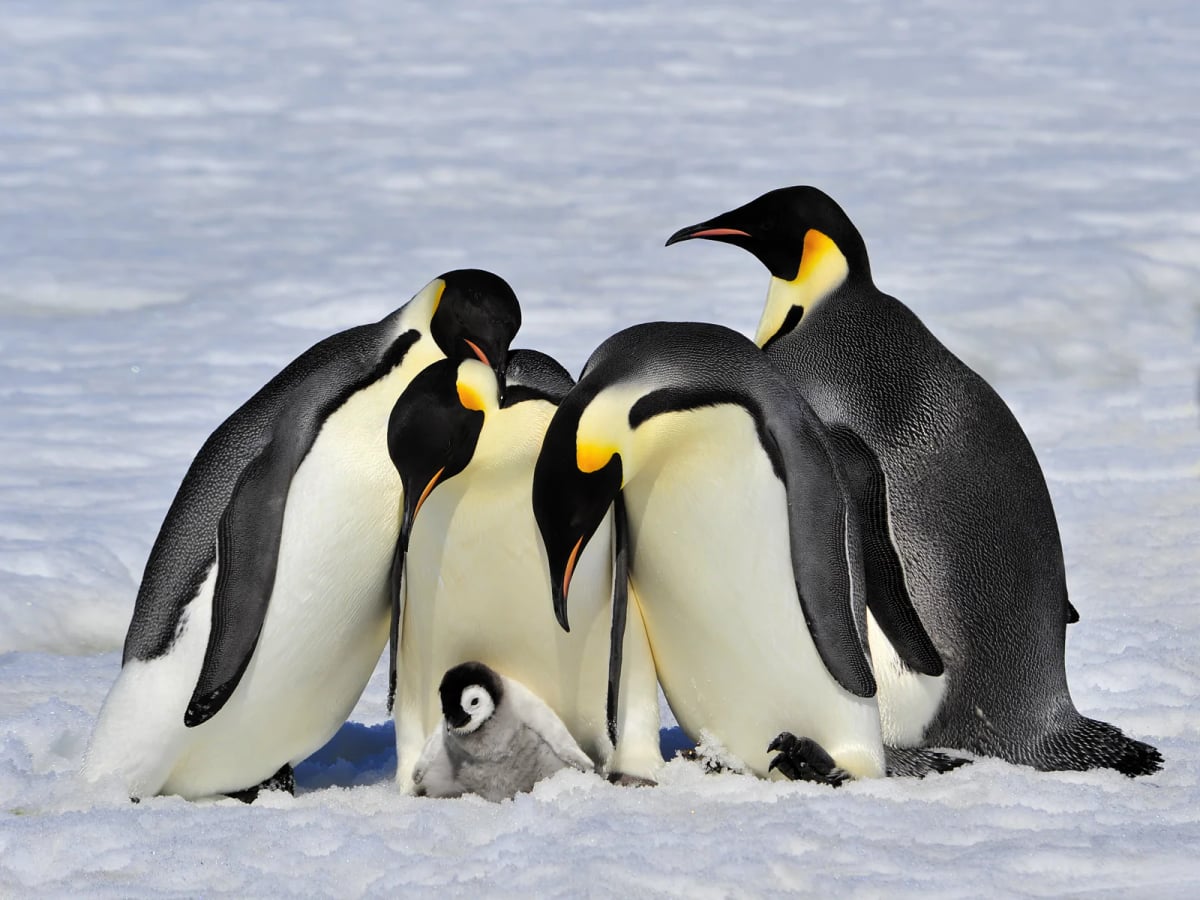
The emperor penguin (Aptenodytes forsteri) is the largest penguin in the world and the only bird that breeds on the sea ice of Antarctica in the middle of the polar winter. Adults stand about 1 to 1.3 meters tall and weigh about 22 to 45 kilograms, with a black head and back, a white belly, a pale yellow chest and bright yellow orange patches on the sides of the neck. Emperor penguins live only around Antarctica, where they breed in colonies on fast ice, the sea ice that stays attached to the coast, and feed in the cold surrounding ocean on fish, krill and squid. They are superb divers that can reach depths of more than 500 meters and stay underwater for over 20 minutes. Their breeding cycle is one of the toughest in the animal world. In autumn they walk tens of kilometers across the ice to their colonies, and after the female lays a single egg, the male holds it on his feet under a fold of skin for about two months of darkness, wind and cold, huddling with thousands of other males and eating nothing while the female feeds at sea. Their survival depends on stable sea ice, and as it breaks up earlier and becomes less reliable with a warming climate, many colonies have failed to raise chicks. In 2026 the IUCN moved the emperor penguin from Near Threatened to Endangered.
Emperor Penguin Size and Appearance
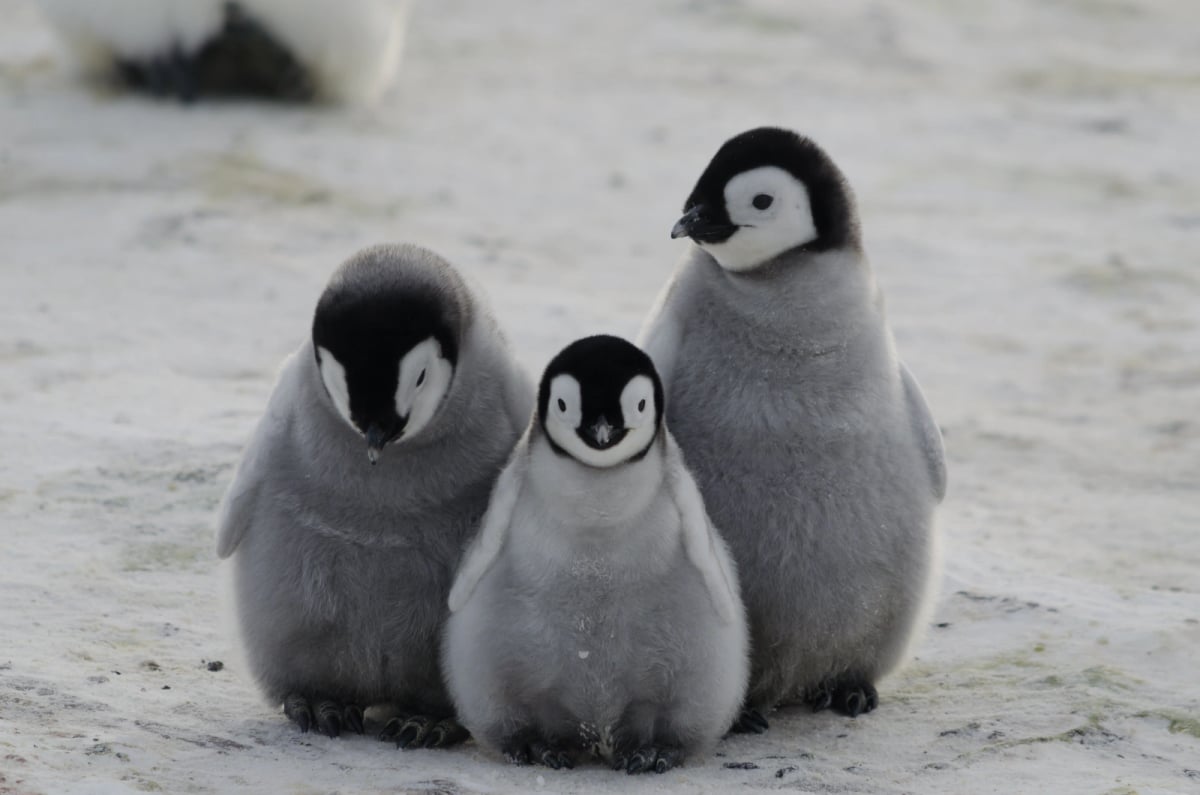
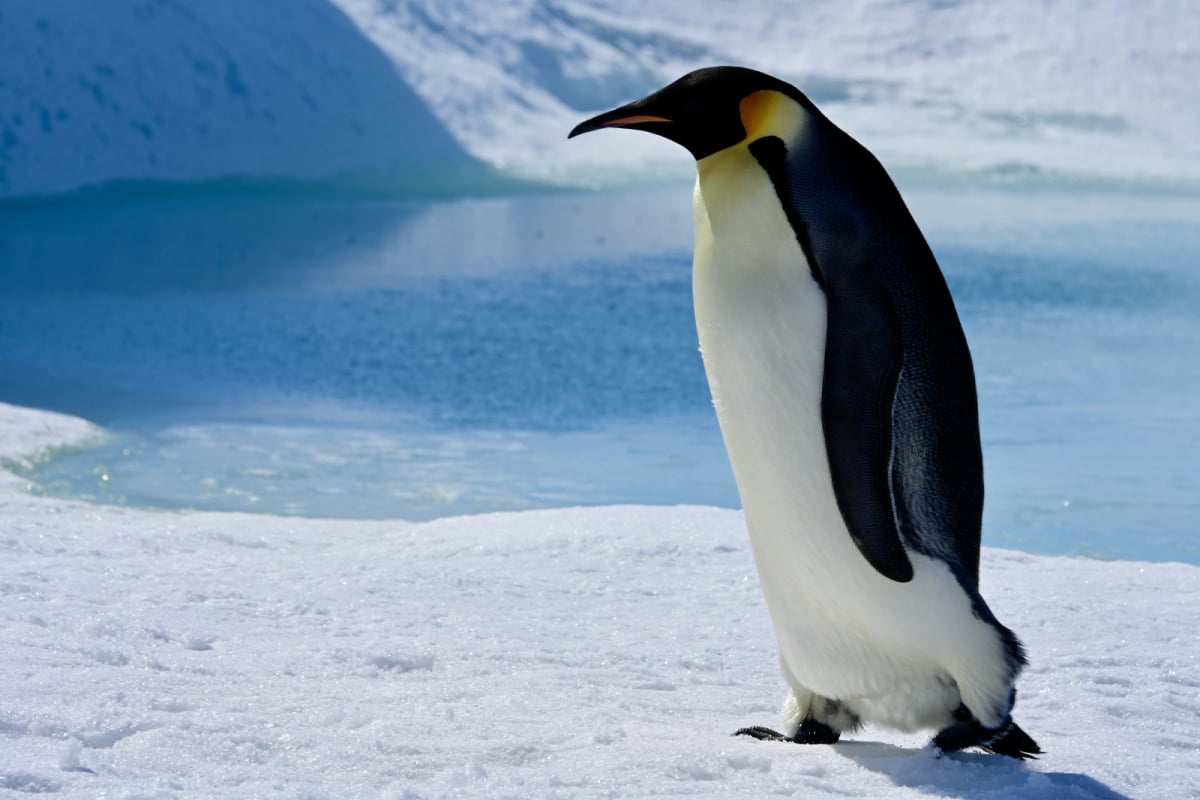
The emperor penguin is the tallest and heaviest of the 18 or so penguin species alive today. Adults usually stand about 1 to 1.3 meters tall, roughly the height of a six or seven year old child, and weigh about 22 to 45 kilograms. Their weight changes a lot through the year: males are at their heaviest when they arrive at the colony in autumn and can lose close to half their body weight during the long winter fast. The body is large and streamlined, with short, stiff flippers that work as wings underwater, short legs set far back and a short tail that helps the bird balance when it stands upright. The head, chin, throat and back are black, the belly is white, and the upper chest has a soft wash of pale yellow. On each side of the neck there is a bright yellow to orange patch that fades into white, and the long, slightly curved bill has a pink or orange stripe along the lower half. Males and females look alike, although males tend to be a little larger. The emperor is often confused with the king penguin, its only close relative in the genus Aptenodytes. The emperor is larger and heavier, with paler yellow neck patches, while the king has bright orange, spoon shaped ear patches and lives on subantarctic islands farther north. Emperor chicks are covered in silvery gray down with a black head and white face, and they keep that fluffy look for several months.
Emperor Penguin Habitat and Range
Emperor penguins live only in Antarctica and the Southern Ocean that surrounds it. They are found all the way around the continent, mostly between about 66 and 78 degrees south, and they are not found in the Arctic: no penguin lives in the wild in the northern polar region. Their key habitat is fast ice, the flat sea ice that forms in winter and stays attached to the coast, to glacier fronts or to stranded icebergs. That is where they breed, because it is solid enough to hold a colony for many months and close enough to open water for the adults to reach the sea. A few colonies breed on ice shelves or on land, but most need fast ice that forms in autumn and lasts until the chicks are ready to swim in early summer. Satellite images, which reveal colonies by the brown stains of droppings on the snow, show about 66 known colonies around Antarctica, some with fewer than a thousand pairs and the largest with tens of thousands of birds. Some of the best known are Snow Hill Island in the Weddell Sea, Atka Bay near the German Neumayer station, Cape Washington and Cape Crozier in the Ross Sea and Pointe Géologie in Adélie Land, near the French Dumont d'Urville station, where the documentary March of the Penguins was filmed. Outside the breeding season, emperors spread out across the pack ice and open ocean, and lone birds occasionally wander as far as South America, the Falkland Islands or New Zealand.
Emperor Penguin Diet and Diving
Emperor penguins are carnivores that find all their food in the sea. Their diet is made up mainly of fish, especially the Antarctic silverfish, along with Antarctic krill and squid. The mix changes with the place and the season: in some colonies fish make up most of the diet, while in others krill or squid are more important. Emperors are the deepest diving birds in the world. Most of their dives are shallower than 100 meters and last a few minutes, but they regularly reach several hundred meters, and the deepest dive recorded reached about 564 meters. The longest dives have lasted more than 20 minutes, and one bird was recorded underwater for about 32 minutes. To manage this, they have solid, heavy bones instead of the hollow bones of flying birds, a large amount of oxygen stored in their blood and muscles, and the ability to slow their heart and shut down blood flow to parts of the body that can wait. They hunt by sight in water that is dark and very cold, chasing fish and squid and sometimes picking prey from the underside of the sea ice. A foraging trip can last days or weeks and take a bird more than 1,000 kilometers away from the colony. Leopard seals and orcas hunt emperor penguins in the water, so birds often gather at the ice edge before jumping in together.
Emperor Penguin Breeding, Eggs and Chicks
Emperor penguins breed in the coldest and darkest time of the year. In March and April, at the start of the Antarctic autumn, adults leave the sea and walk or slide on their bellies across the newly formed ice to their colonies, a journey that can cover from a few to more than 100 kilometers. Pairs form after noisy displays, and each bird recognizes its partner by its call. In May or June the female lays a single large egg, which weighs about 450 grams, and carefully passes it to the male. She then returns to the sea to feed, often walking a long way to reach open water. The male balances the egg on his feet and covers it with a warm fold of feathered skin called the brood pouch. For about 65 days, through the polar night, with temperatures that can fall below minus 40 degrees Celsius and strong winds, he keeps the egg warm without eating, living on his fat. By the time the chick hatches in July or August, many males have gone about four months without food. If the female is not back yet, the male can feed the chick a milky secretion from his throat. When the female returns she takes over, feeding the chick with food she brings up from her stomach, and the male finally walks back to the sea. The parents then take turns feeding the chick. At about seven weeks old, the chicks gather in groups called crèches, and in December or January, at around five months old, they lose their down and head out to sea on their own.
How Emperor Penguins Survive the Cold
Few animals face conditions as harsh as an emperor penguin in winter, and its body is built for them. The plumage is the densest of any bird, with about four layers of short, overlapping feathers that trap a layer of warm air and keep out wind and water. Beneath the skin a thick layer of fat insulates the body and stores the energy that males need to survive their long fast. Even the feet and flippers are adapted. Arteries and veins run side by side, so warm blood flowing out passes its heat to the cold blood returning to the body, and very little heat is lost to the ice; the birds also rock back on their heels and tails to keep less of their feet in contact with the ground. The nasal passages recover much of the heat and moisture from each breath before it leaves the body. The most famous strategy is the huddle. During the winter storms, thousands of males press together in tight groups, standing so close that the temperature inside the huddle can rise above 20 degrees Celsius, and sometimes much higher, while the air outside is far below freezing. The huddle is always moving. Birds on the windy edge slowly work their way toward the warm center, and those in the middle drift toward the outside, so every bird gets its turn in the warmth. Because huddling saves so much energy, the males can make it through months without food.
Emperor Penguin Population and Conservation Status
In April 2026 the IUCN moved the emperor penguin from Near Threatened to Endangered on its Red List, after a review led by BirdLife International. Counting emperor penguins is difficult, because their colonies are remote and most breeding happens in the dark winter, so scientists rely on satellite images. A study published in 2024 estimated about 228,000 adult birds at 50 colonies in 2018, around 10 percent fewer than in 2009, and a 2025 study of colonies in the Antarctic Peninsula, the Weddell Sea and the Bellingshausen Sea found a decline of about 22 percent between 2009 and 2024. The main threat is the loss of the sea ice the penguins need to breed. Since 2016 Antarctic sea ice has fallen to record lows, and when the fast ice breaks up before the chicks have grown their waterproof feathers, they drown or freeze. This has already happened on a large scale. Halley Bay in the Weddell Sea, once the second largest colony, lost almost all its chicks for several years in a row from 2016, and in 2022 four of the five colonies in the central Bellingshausen Sea failed to raise chicks when the ice melted early. Projections suggest that the global population could fall by about half by the 2080s if warming continues on its current path. The emperor penguin is also listed as threatened under the United States Endangered Species Act since 2022, and its colonies are protected under the Antarctic Treaty system, but its long term future depends above all on limiting climate change.