Nile Crocodile
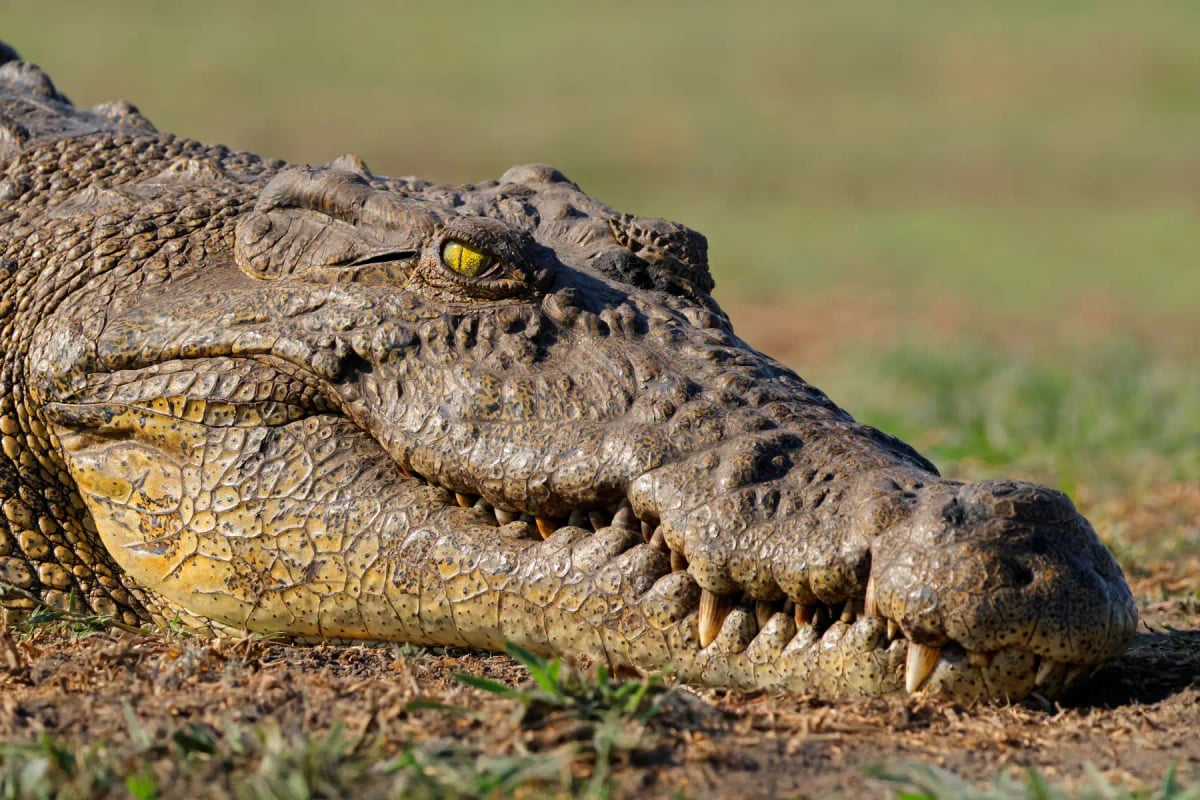
The Nile crocodile is the largest reptile in Africa and the second largest in the world after the saltwater crocodile, with adult males usually measuring 3.5 to 5 meters and weighing 225 to 750 kilograms, and the biggest passing 6 meters. Found across rivers, lakes and wetlands from Egypt to South Africa and on Madagascar, it thrives in fresh water and occasionally in brackish estuaries. A powerful predator, it feeds mainly on fish, but large individuals can overpower animals as big as wildebeest, zebra and buffalo. Its hunting method relies on patience: it lies motionless at the water's edge, then strikes with remarkable speed, clamping prey in its jaws and pulling it underwater. Despite being listed as Least Concern by the IUCN, populations in certain areas face pressure from habitat loss, pollution, hunting and conflict with local communities that depend on rivers and lakes for their livelihoods.
What is a Nile crocodile?
The Nile crocodile, Crocodylus niloticus, is the largest crocodile in Africa and the second largest reptile in the world after the saltwater crocodile. It is a true crocodile, with a long, fairly broad snout and teeth that stay visible when the mouth is closed, olive to bronze skin with dark bands on the tail, and eyes, ears and nostrils set on top of the head so it can see, hear and breathe while almost completely submerged. Its name comes from the Nile, where it was famous in the ancient world, but most Nile crocodiles live far from that river, in the lakes, rivers and swamps of eastern, central and southern Africa and Madagascar. For a long time the crocodiles of West Africa were also counted as Nile crocodiles. Genetic studies published between 2003 and 2015 showed that they are a separate species, the West African crocodile, Crocodylus suchus, which is smaller and less aggressive. Today the Nile crocodile in the strict sense is the crocodile of eastern and southern Africa.
Where do Nile crocodiles live?
The Nile crocodile lives in 26 countries, from Egypt and Sudan south through East Africa to South Africa, west to Angola, Gabon and Cameroon, and on Madagascar. It occupies large rivers, lakes, swamps, floodplains and reservoirs, and sometimes estuaries and mangroves, preferring slow or still water with sandy banks for basking and nesting. In the dry season it may walk overland to reach permanent water, and in some places it shelters in burrows or, in Madagascar's Ankarana, even in caves. The classic places to see Nile crocodiles are the Mara River in Kenya and Tanzania during the wildebeest crossings, Lake Turkana, the Victoria Nile below Murchison Falls in Uganda, the Rufiji River in Tanzania's Nyerere National Park, the Luangwa and Lower Zambezi in Zambia, Lake Kariba in Zimbabwe, the Okavango Delta in Botswana, Lake St Lucia in South Africa and Lake Chamo in Ethiopia, where large crocodiles gather at a spot known as the Crocodile Market.
Are there crocodiles in the Nile River?
Yes, but not along the whole river anymore. In ancient times crocodiles lived along the entire Nile, down to the delta on the Mediterranean, and they were part of Egyptian life and religion: the god Sobek had a crocodile head, the city of Shedet in the Faiyum was called Crocodilopolis by the Greeks, and thousands of crocodiles were mummified, some of which can be seen today in the Crocodile Museum at Kom Ombo. Hunting with firearms and steamboat traffic in the nineteenth century pushed them south, and by around 1900 they had practically disappeared from Egypt below Aswan. Today the Egyptian crocodiles live in Lake Nasser, the reservoir created by the Aswan High Dam, where a 2008 and 2009 survey estimated about 2,500 at the surface, although poaching has reduced them since. Farther south, Nile crocodiles live in Lake Nubia in Sudan, the Sudd swamps of South Sudan, the Victoria Nile in Uganda, where boats below Murchison Falls pass some of the largest crocodiles in Africa, and Lake Victoria, one of the sources of the river.
How big is the Nile crocodile? The biggest ever recorded
Adult male Nile crocodiles usually measure 3.5 to 5 meters and weigh 225 to 750 kilograms. Females are about a third smaller, usually 2.5 to 3.5 meters long. Very old males can pass 6 meters and a tonne. The largest Nile crocodile measured with reasonable accuracy was a male shot near Mwanza, on Lake Victoria in Tanzania, which measured 6.45 meters and was estimated to weigh around 1,000 to 1,100 kilograms. The most famous big Nile crocodile is Gustave, a huge male of the Rusizi River and the north of Lake Tanganyika in Burundi, estimated at around 6 meters. He was blamed for dozens or even hundreds of deaths, a number that was never verified, and he was never captured despite several attempts; he has not been seen with certainty for years. Claims of Nile crocodiles of 7 meters or more have never been confirmed. Size also varies by population: crocodiles in cooler southern Africa or in crowded lakes tend to be smaller than those of large tropical rivers.
What do Nile crocodiles eat?
Fish are the main food of the Nile crocodile for most of its life, especially catfish, tilapia and other common species. Hatchlings eat insects, spiders, frogs and small fish, and as they grow they add birds, turtles, monitor lizards and mammals. Large adults take antelopes, wildebeest, zebras, warthogs, porcupines and even buffalo, young hippos and giraffes that come to drink, and they also eat carrion. The most famous hunting scene happens on the Mara River between July and October, when hundreds of thousands of wildebeest and zebras cross the river during the Great Migration and crocodiles wait at the crossings. The method is always the ambush: the crocodile waits almost submerged, lunges, grips the prey and drags it underwater to drown it, then spins in the death roll to tear off pieces, since it cannot chew. Several crocodiles often feed together on one carcass, holding it with their jaws while others pull. Because their metabolism is very slow, large Nile crocodiles can go many months without a big meal.
Are Nile crocodiles dangerous? Why they are so aggressive
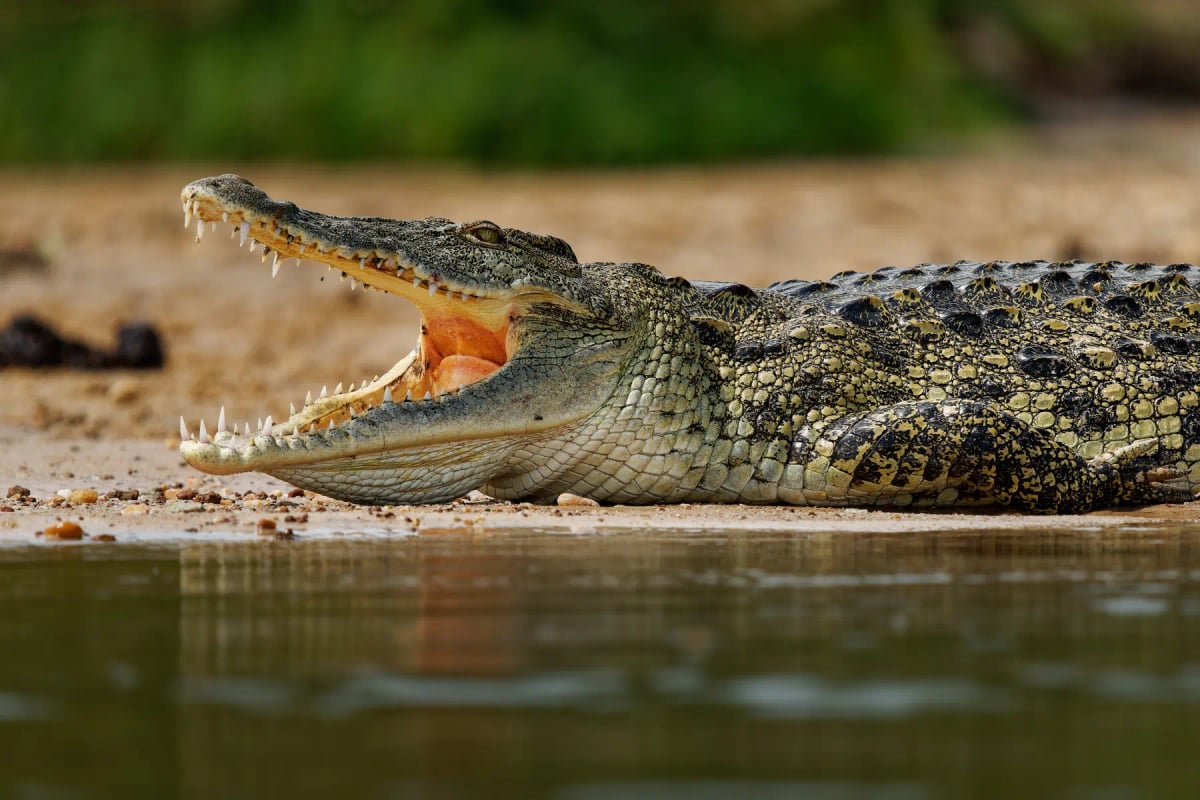
Yes. The Nile crocodile is one of the most dangerous animals in Africa and, together with the saltwater crocodile, the crocodile that kills the most people. It is thought to kill hundreds of people a year, although the real number is unknown because many attacks in remote villages are never reported. It is aggressive for simple reasons: large adults treat any animal at the water's edge, including people, as possible prey; males defend territories; and females guard their nests and young. Most victims are people who fetch water, wash, bathe or fish in rivers and lakes, often because they have no other source of water, and attacks rise when droughts concentrate crocodiles and people in the same pools. Mozambique, Zambia, Tanzania, Uganda, Malawi and Madagascar report many cases. Fenced water points, boreholes that keep people away from the river and community warnings have reduced attacks in some areas. The basic rules are to never swim or wade in crocodile water, keep back from the edge and avoid the same spot every day, since crocodiles learn routines.
Behavior: basking, groups and cooperation
Nile crocodiles are more social than their reputation suggests. They often bask together on sandbanks, sometimes dozens at a time, with the largest males taking the best spots, and they share feeding sites with relatively little fighting. They are active by day and night: they usually bask in the morning, lie with their mouths open in the heat of the day to cool down and hunt mostly at dusk and at night. Several observations describe Nile crocodiles working together, forming a semicircle across a river to herd fish toward each other, and taking turns at a carcass. Dominant males hold territories in the breeding season and display with head slaps on the water, deep bellows and underwater sounds that make the surface vibrate. In the dry season, when pools shrink, crocodiles may move overland to other water, and in very hot or dry periods some dig burrows in the banks and stay there for weeks. Young crocodiles stay in groups called crèches near their mother for several weeks.
Nests and babies
Nile crocodiles reach maturity at around 12 to 16 years, when females are about 2.5 meters long. They nest in the dry season, and the female digs a hole in a sandy bank, often in the same area every year, and lays an average of about 50 eggs, sometimes as many as 80. She covers the nest and stays nearby for the whole incubation of around 80 to 90 days, barely eating, because Nile monitor lizards, hyenas, mongooses, baboons and people dig up eggs. The temperature of the nest decides the sex of the babies, with males produced at intermediate temperatures. When the hatchlings call from inside the eggs, the mother digs them out, may help crack the shells with her mouth and carries them to the water in her jaws, sometimes helped by the father. The young stay together near her for weeks or months, but birds, fish, monitors and larger crocodiles eat most of them, and only a small fraction survive to adulthood.
Is the Nile crocodile endangered? How many are left
No. The IUCN lists the Nile crocodile as Least Concern, with an estimated 50,000 to 70,000 mature adults in the wild according to its 2019 assessment, plus many more juveniles. That is far fewer than in the past: skin hunting between the 1940s and the 1970s killed millions and emptied many rivers, until legal protection and trade controls allowed most populations to recover. Today the strongest populations are in eastern and southern Africa, while in some countries crocodiles are scarce or declining. The main threats are the damming and drainage of rivers and wetlands, pollution, drowning in fishing nets, illegal hunting for meat and skins, and the killing of crocodiles after attacks. Pollution can be deadly: in the 2000s and 2010s, dozens of crocodiles died of pansteatitis, an inflammation of body fat, in the Olifants River in Kruger National Park and at Loskop Dam in South Africa. International trade is controlled by CITES: the species is in Appendix I in most countries and in Appendix II in several eastern and southern African countries that run regulated farming and ranching.