Harbor Seal
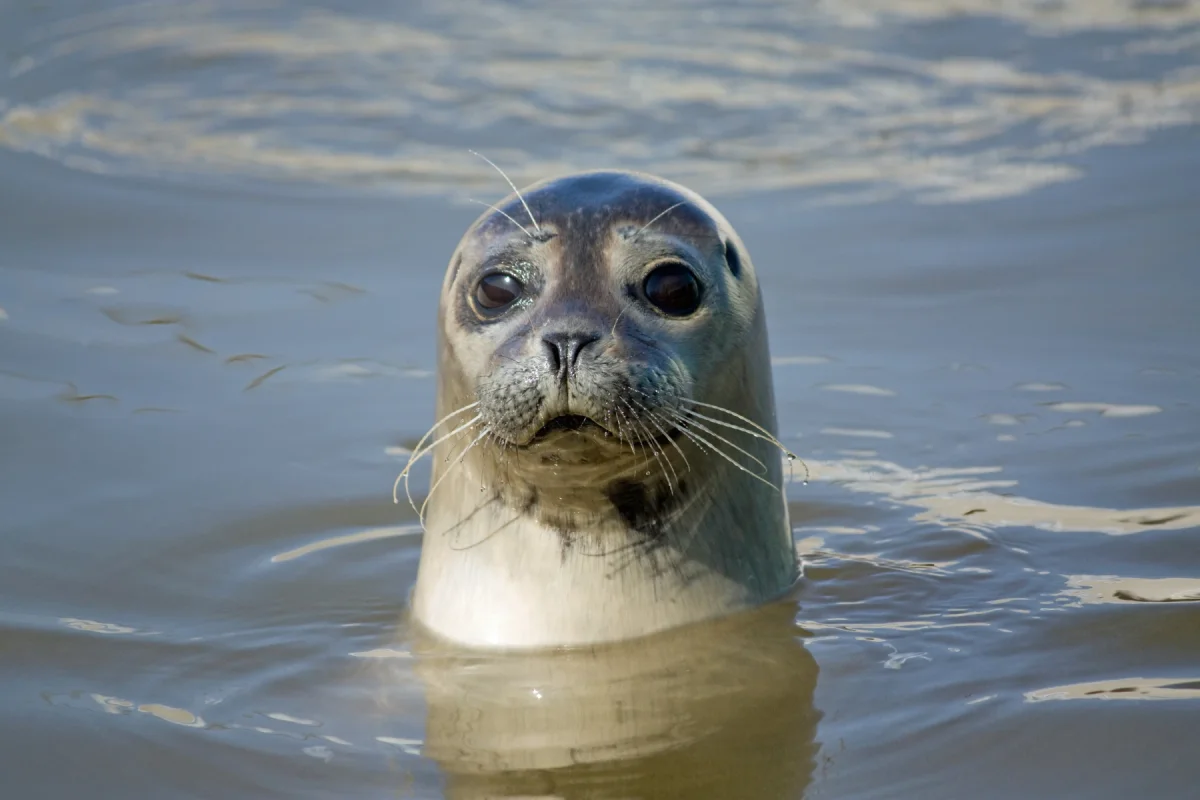
The harbor seal (Phoca vitulina), also spelled harbour seal and called the common seal in Britain, is one of the most widely distributed seals in the world, living along temperate and Arctic coasts of the North Atlantic and North Pacific. Its rounded head, dog like face, V shaped nostrils, large dark eyes and coat covered in spots make it easy to recognize. A capable diver, it can stay underwater for up to about 30 minutes and has been recorded at depths of around 500 meters, although most of its hunting happens in shallow coastal water, where it catches fish, squid and crustaceans. Harbor seals rest on sandbanks, rocky shores, beaches and floating ice, alone or in small loose groups. Females give birth to a single pup between February and July, depending on the region. Pups can swim within hours of being born and are weaned in three to six weeks. The species is listed as Least Concern by the IUCN, though some regional populations, such as those of Orkney, Iceland and Greenland, have fallen sharply.
What is a harbor seal?
The harbor seal, Phoca vitulina, is a true seal, a member of the family Phocidae, which means it has no external ears and moves on land by wriggling on its belly instead of walking on its flippers like sea lions. Its name changes with the country: Americans write harbor seal, the British and Irish write harbour seal or call it the common seal, and in Spanish it is the foca común. It is one of the most widespread seals on Earth, found on both sides of the North Atlantic and the North Pacific. Scientists recognize several subspecies. The eastern Atlantic seal lives in Europe, another group lives on the American Atlantic coast, and the Pacific seal ranges from Baja California to Alaska and across to Japan and Russia, where the Kuril seal is sometimes treated as a subspecies of its own. The rarest is the Ungava or Lacs des Loups Marins seal of northern Quebec, which has lived only in fresh water for thousands of years and may number about 100 animals.
How big do harbor seals get?
The harbor seal is a medium sized seal. Adults reach up to about 1.85 meters in length and weigh between 55 and 168 kilograms, with males usually larger and heavier than females. Weight changes a lot through the year: seals are heaviest before the breeding season and lose a good part of their fat while nursing, mating and molting. Pups are born at around 10 kilograms, and up to 16, and they can double that weight in the few weeks they spend nursing. The coat is short and covered in small dark spots or rings, but its color varies widely, from silver gray and pale tan to almost black, so two seals on the same sandbank can look very different. Every seal has its own pattern, and researchers use photos of the spots to recognize individuals over the years. The face is the easiest clue: a round head, a short muzzle that gives it the look of a puppy, and nostrils that form a V when seen from the front.
Harbor seal or grey seal?
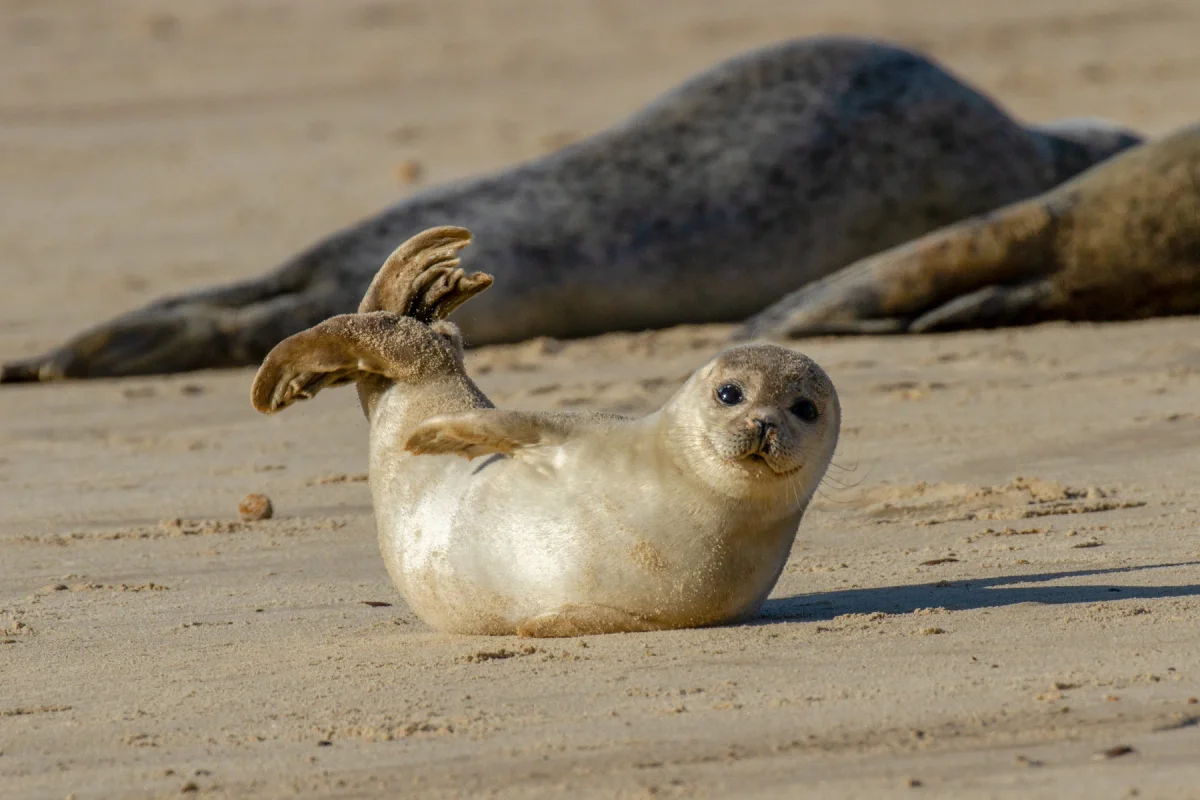
In much of Europe and in New England, harbor seals share beaches with the grey seal, and the two are often confused. The quickest way to tell them apart is the head. The harbor seal has a round head, a short, concave profile like a dog's and V shaped nostrils, while the grey seal has a long, straight or arched nose, often called a Roman nose, and nostrils that run almost parallel. Size helps too: grey seal males can be twice as heavy as a large harbor seal. Their pups are also very different. Harbor seal pups shed their white fetal coat before birth, are born ready to swim and follow their mother into the water within hours. Grey seal pups are born in a thick white coat and stay on land for about three weeks. The two even breed at different times: harbor seals give birth in late spring or summer, grey seals in autumn and winter. In the United Kingdom, grey seals are now far more numerous than harbor seals.
Where do harbor seals live?
Harbor seals have one of the broadest ranges of any seal, stretching across the coasts of the North Atlantic and North Pacific oceans. They are at home in sheltered estuaries, sandy bays, rocky shorelines, harbors and Arctic fjords, and some even live in lakes. In the Atlantic, they occur from the eastern coast of Canada and the United States, where they winter as far south as New York and the Carolinas, to Greenland, Iceland, Norway, the British Isles and the Wadden Sea, with the southernmost European colonies in France. In the Pacific, their range runs from Baja California through California, Oregon, Washington and British Columbia to Alaska, and across to the Kamchatka coast, the Kuril Islands and Hokkaido in Japan. Rather than undertaking long migrations, harbor seals stay close to familiar stretches of coastline throughout the year, usually feeding within a few dozen kilometers of their resting sites and returning again and again to the same rocks and sandbanks.
What do harbor seals eat?
Hunting is where the harbor seal truly excels. It feeds on a wide variety of prey, including fish such as herring, sand eels, cod, salmon and flatfish, as well as squid, octopus and crustaceans. The exact menu varies by location and season, since seals are opportunistic and take whatever is most available locally, and an adult eats around 5 percent of its body weight a day. Most hunting happens in shallow coastal water, with dives of a few minutes, but harbor seals can hold their breath for up to about 30 minutes and dives of around 500 meters have been recorded, slowing their heart rate dramatically to save oxygen. Their large, sensitive eyes help them spot prey in murky or dimly lit water. Whiskers, known as vibrissae, are just as important: they can detect the tiny movements in the water left behind by a fish that has already swum past, which lets seals hunt even in total darkness.
Why do harbor seals haul out?
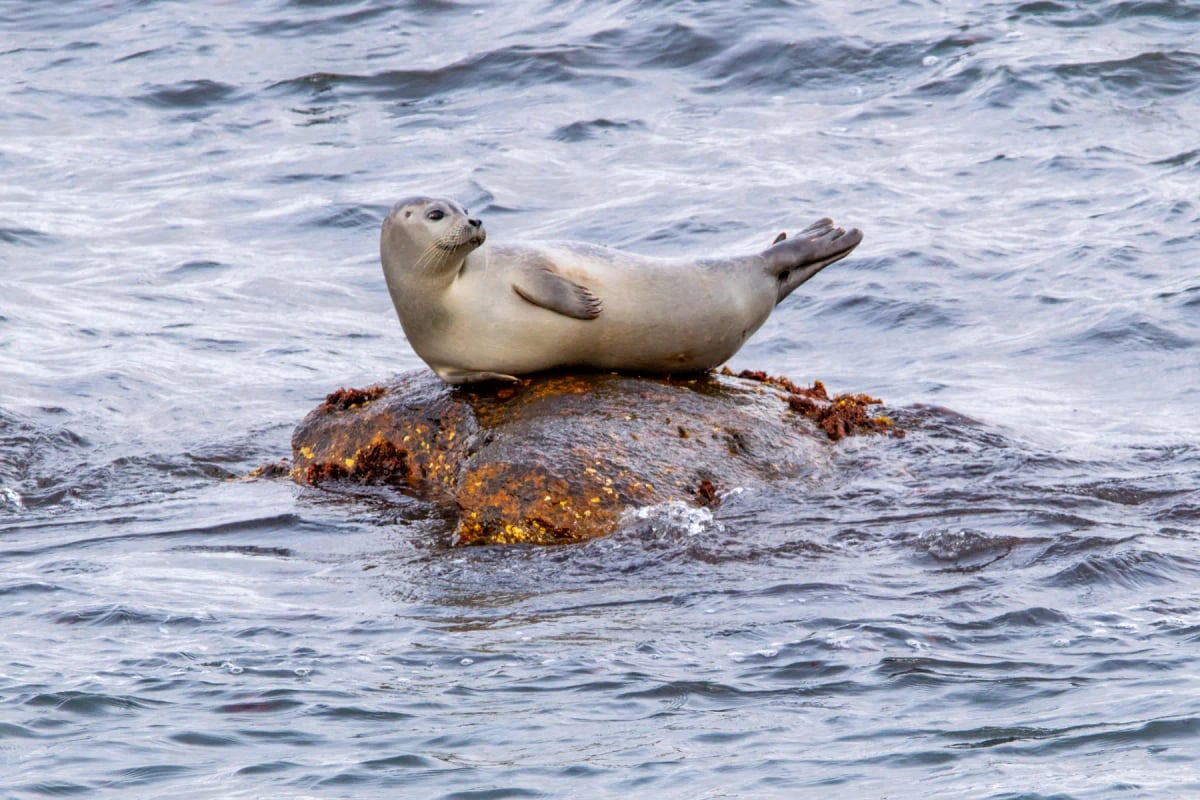
Between feeding trips, harbor seals spend a considerable amount of time out of the water. This behavior, called hauling out, takes place on sandbanks, rocky reefs, sheltered beaches, and even floating ice in colder regions. Seals use these resting sites to sleep, warm up in the sun, molt their coats once a year, and nurse their pups. Unlike many other species of pinnipeds, harbor seals tend to gather in loose, relaxed groups rather than dense colonies, and individuals often keep a comfortable distance from one another. They are sensitive to disturbance while hauled out, and repeated disruption by boats or people on foot can cause them to abandon important resting sites, which takes a real toll on their health over time.
Pups and reproduction
Pups are born in early summer, though the exact timing shifts depending on the region. In warmer southern areas, births can begin as early as February, while in Arctic zones they may not occur until June or July. Each female gives birth to a single pup, which arrives already capable of swimming. Within hours of being born, a pup can enter the water alongside its mother. Nursing lasts between three and six weeks, during which the pup grows rapidly on its mother's fat rich milk. Once weaned, it must fend for itself. Mating takes place in the water shortly after the pup is weaned. Males compete for access to females, though harbor seals are far less aggressive about this than species that form large breeding colonies on land.
Are harbor seals endangered?
The IUCN lists the harbor seal as Least Concern, with an estimated 350,000 to 500,000 animals worldwide, and in many regions populations recovered after hunting and bounty programs ended in the 20th century. The Wadden Sea is the clearest example: 23,772 seals were counted there in August 2024, close to the level of 1900, despite distemper outbreaks that killed about 18,000 seals in Europe in 1988 and many thousands more in 2002. The global picture hides some steep local declines, though. Orkney has lost around 85 percent of its harbor seals since 1997, Iceland counted about 70 percent fewer in 2020 than in 1980, and Greenland has fewer than 1,000, so the species is Critically Endangered there. The freshwater Lacs des Loups Marins seal of Quebec is Endangered in Canada. Entanglement in fishing nets, conflicts with fisheries, disturbance at resting sites, pollution and competition with growing numbers of grey seals are among the pressures, and climate change adds uncertainty in the Arctic parts of their range.
Where it is found
The Harbor Seal can be found in places such as: