Ethiopian Wolf
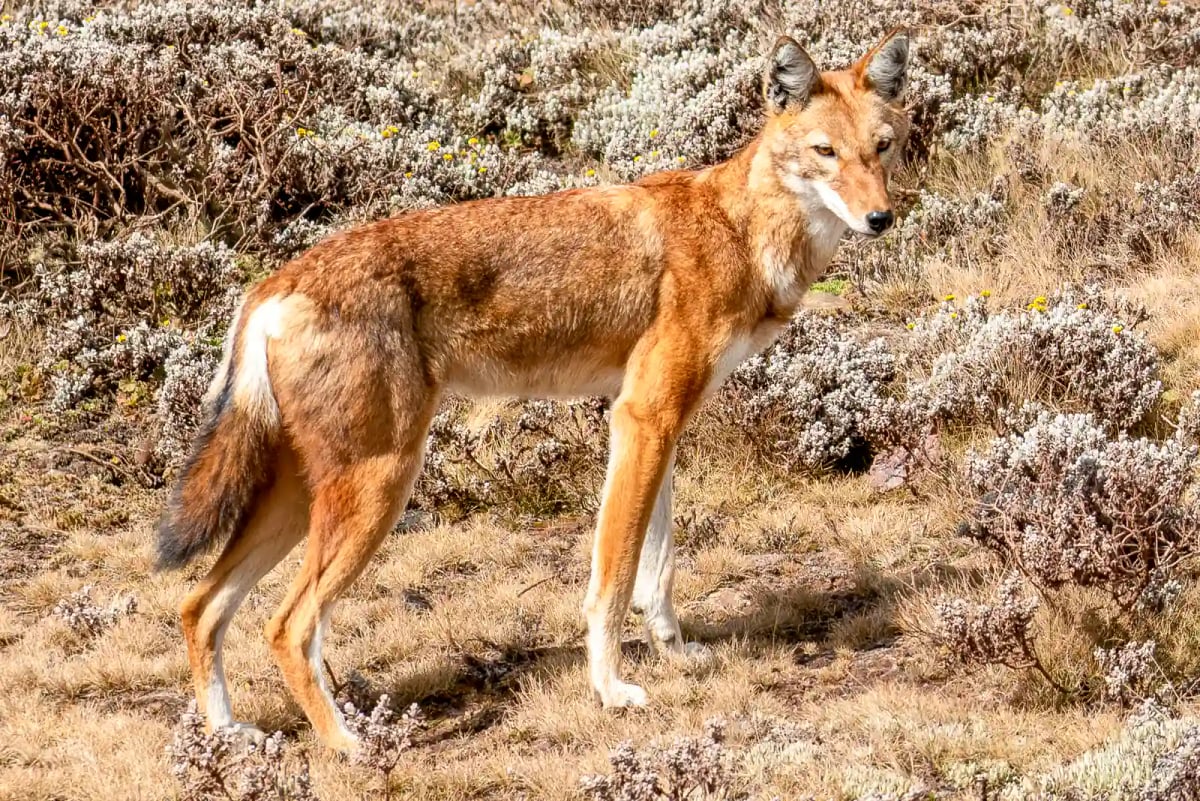
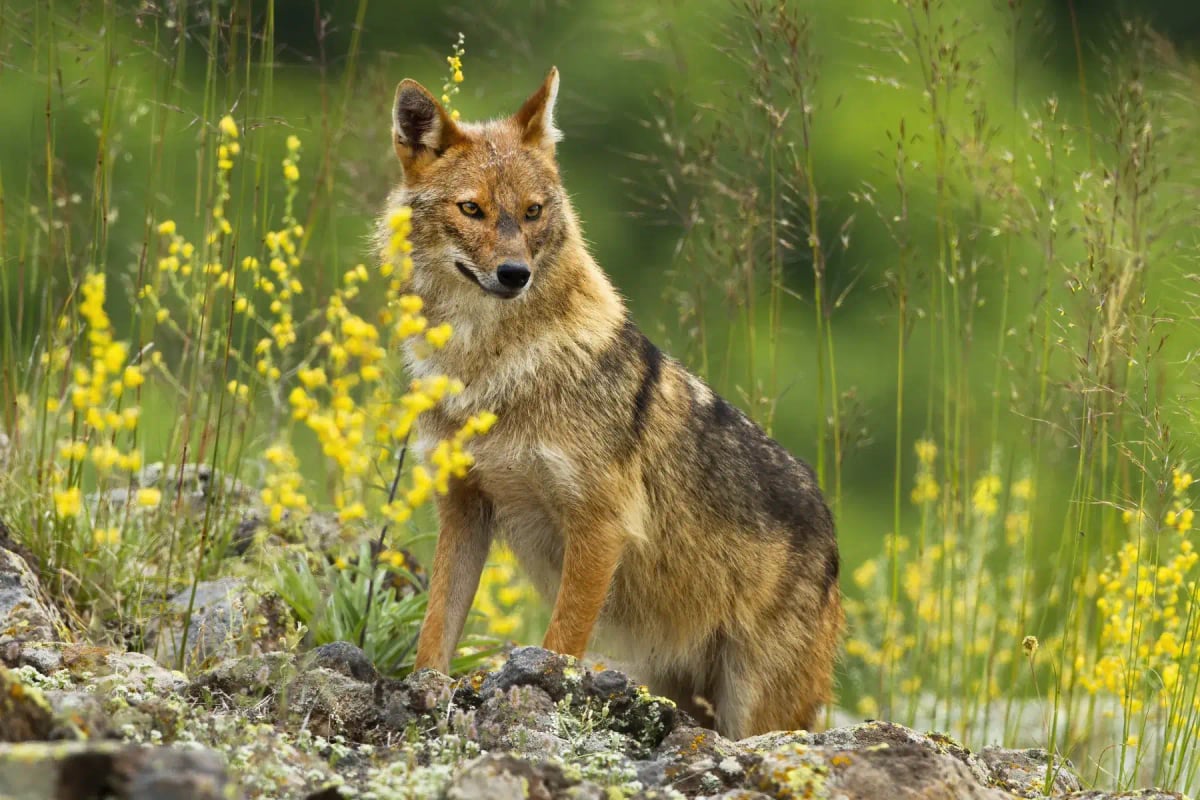
The Ethiopian wolf (Canis simensis), also called the Abyssinian wolf or Simien jackal, is the rarest wild dog in the world and the most endangered carnivore in Africa. It lives only in the highlands of Ethiopia, in cold afroalpine grasslands and heath above about 3,000 meters, where fewer than 500 adults survive in six separate mountain ranges. It is a slim, long legged wolf with a narrow, pointed muzzle, large ears and a bright reddish coat, with white on the throat, chest, belly and inner legs and a bushy tail that turns black toward the tip. Ethiopian wolves live in close family packs that share a territory, greet each other noisily and patrol their borders together, but they almost always hunt alone. Their diet is unusual for a wolf: they feed mostly on rodents active by day, above all mole rats and grass rats, which they catch by stalking slowly and pouncing or by digging them out of their burrows. Only the dominant female of each pack usually breeds, and the rest of the pack helps feed and guard the pups. The IUCN lists the Ethiopian wolf as Endangered. Its main threats are the loss of highland habitat to farming and grazing and diseases such as rabies and canine distemper caught from domestic dogs.
What is an Ethiopian wolf?
The Ethiopian wolf is a wild member of the dog family that lives only in the mountains of Ethiopia, in the Horn of Africa. Its scientific name is Canis simensis, which places it in the genus Canis together with the gray wolf, the coyote, the jackals and the domestic dog. It has gone by many names over the years. In English it is also called the Abyssinian wolf, after the old name of Ethiopia, and in older books it appears as the Simien fox, Simien jackal or red jackal, because its slim body and red coat reminded early naturalists of those animals. Genetic studies have settled the question: it is a true wolf, more closely related to the gray wolf and the African golden wolf than to any jackal. Its ancestors are thought to have reached the Ethiopian highlands from Eurasia during the last ice age, when cold grasslands covered much more of the region. As the climate warmed, those grasslands shrank to the highest mountain tops, and the wolves were left behind on them like islands. Today the Ethiopian wolf is the rarest wild canid on Earth and one of the best known symbols of Ethiopia's unique highland wildlife.
How big is an Ethiopian wolf?
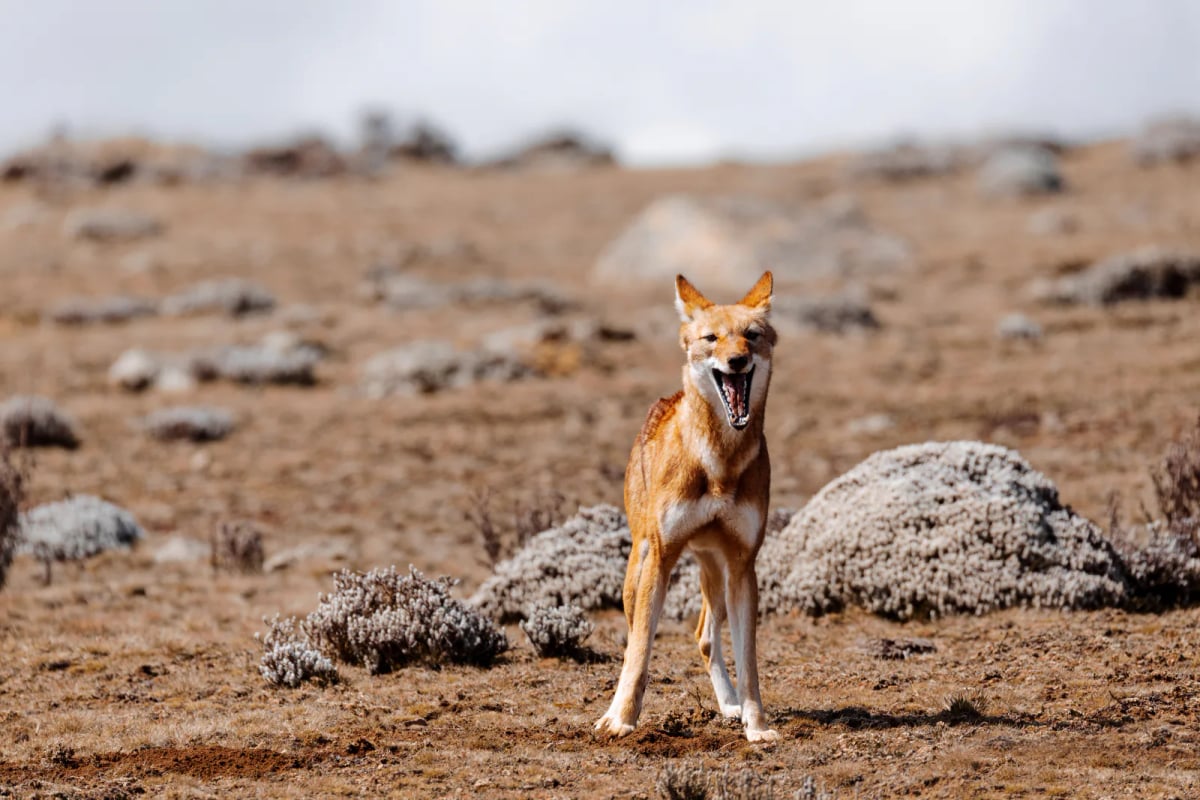
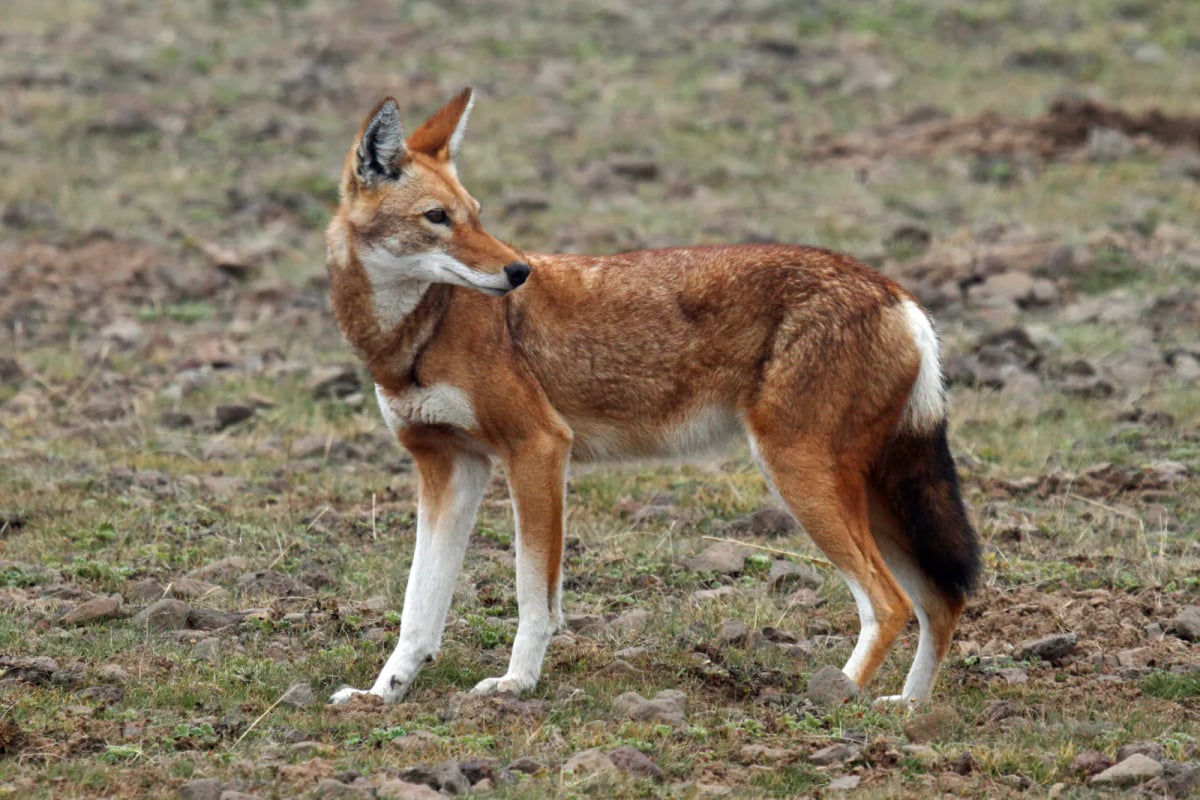
The Ethiopian wolf is a medium sized canid, about the size of a large coyote and much lighter than a gray wolf. Its head and body measure about 84 to 101 centimeters, the tail adds another 27 to 40 centimeters, and it stands about 53 to 62 centimeters at the shoulder. Adults weigh about 11 to 20 kilograms. Males are clearly larger than females: the Ethiopian Wolf Conservation Programme gives an average of about 16 kilograms for males and 13 kilograms for females. The body is slender and the legs are long, which gives the wolf a light, almost fox like look when it trots across the grassland. The muzzle is long and narrow, an adaptation for pulling small rodents out of their burrows, and the teeth are smaller and more widely spaced than those of other wolves. The ears are large, pointed and set well apart. The coat is a bright reddish orange to tawny, with a white throat band, white chest and belly, white on the inside of the legs and a white patch under the tail. The bushy tail is reddish near the base and turns dark brown to black toward the tip. Females tend to be paler, especially in the breeding season.
Ethiopian wolf habitat: where does it live?
The Ethiopian wolf lives only in Ethiopia, and only in the highest parts of the country. Its habitat is the afroalpine zone, the cold, open land above the tree line, usually between about 3,000 and 4,500 meters above sea level. These are grasslands, heathlands and moorlands dotted with giant lobelias, everlasting flowers and low shrubs, where nights are often below freezing and days can be bright and windy. The best wolf habitat is short grassland with many rodent burrows, where prey is easy to find. Today the wolves survive in six separate populations, cut off from each other by lower land full of farms and villages: the Simien Mountains in the north, the North Wollo and South Wollo highlands, Guassa Menz, the Arsi Mountains and the Bale Mountains in the south. Bale is by far the most important, with more than half of all Ethiopian wolves, and the Sanetti Plateau and the Web Valley inside Bale Mountains National Park hold some of the highest wolf densities known. Other populations are very small; the Simien Mountains, for example, hold only a few dozen wolves. Several small populations have disappeared in recent decades, including those of Mount Choke, Mount Guna and Gosh Meda.
What does the Ethiopian wolf eat?
The Ethiopian wolf is a rodent specialist, which makes its diet very different from that of gray wolves, which hunt deer and other large animals. In the Bale Mountains it feeds almost entirely on small mammals that are active by day, above all the giant mole rat, a large burrowing rodent found only in Bale, and several kinds of grass rats. In other mountain ranges, where the giant mole rat does not live, the wolves eat the smaller common mole rat and other highland rats. The afroalpine grasslands hold enormous numbers of these rodents, and that is what allows a wolf to live there at all. A wolf hunts by walking slowly across the grass, stopping often to listen and watch. When it detects a rodent near a burrow, it creeps closer and pounces, or it digs quickly into the burrow to pull the animal out. Mole rats are the biggest prize, and wolves sometimes wait patiently beside a mound for one to appear. Now and then small groups chase and kill hares, young antelopes or lambs. In 2024 scientists also described Ethiopian wolves licking nectar from the flowers of the Ethiopian red hot poker in Bale, the first time a large carnivore was seen feeding regularly on nectar.
Ethiopian wolf packs and hunting
Ethiopian wolves are social animals that live in packs, but their daily routine mixes life in a group with work done alone. A pack is an extended family, usually of around six adults and sometimes as many as 20 animals older than one year, that shares and defends a territory of about 6 square kilometers on average. Males usually stay in the pack where they were born for life, while most females leave when they reach adulthood, so a pack is often a group of related males with one or a few females. Pack members sleep together in the open, curled up in the grass or in rocky shelters. At dawn, at midday and in the evening they gather for noisy greetings, with tail wagging, licking and calls, and then patrol the edges of their territory together, leaving scent marks and droppings and chasing off wolves from neighboring packs. When it is time to eat, though, they split up and hunt on their own, because a single rodent is too small to share. The wolves are active mainly by day, when their prey is above ground. In the Guassa highlands researchers have seen wolves walking among herds of gelada monkeys while hunting rodents, and those wolves caught prey much more often than wolves hunting away from the monkeys.
Ethiopian wolf pups
In each Ethiopian wolf pack, usually only the dominant female breeds, once a year. Mating takes place between August and November, and females are receptive for only a short time, often less than two weeks. Interestingly, females often mate with males from neighboring packs as well as with males of their own pack, which helps keep the small populations from becoming too inbred. After a pregnancy of about 60 to 62 days, the pups are born between October and December, at the start of the dry season, in a den dug into the ground or hidden among rocks. A litter can have up to seven pups. They stay inside the den for their first weeks and start to come out at about three weeks old, dark and fluffy at first, before slowly gaining the red coat of the adults. The whole pack helps raise them. Other adults bring food, regurgitating meat for the pups, guard the den when the mother is away and play with the young. In some packs a second female that is not the mother even produces milk and helps nurse the pups. Young wolves start hunting rodents within a few months, become sexually mature in their second year and reach full adult appearance at about two years old.
Ethiopian wolf population: how many are left?
Fewer than 500 adult Ethiopian wolves are thought to survive in the wild, which makes this the rarest wild canid in the world. The Ethiopian Wolf Conservation Programme, which has studied and protected the species since the 1990s, currently estimates the total at about 450 wolves, living in a little over a hundred packs spread across six populations. That number has risen and fallen sharply over the years. Most of the wolves live in the Bale Mountains, where the population has crashed several times after outbreaks of rabies and canine distemper and then slowly recovered. The worst crash came in the early 1990s, when disease and shooting during a period of political unrest devastated the wolves of Bale. The other five populations are much smaller, some with only a few packs, and that makes them very vulnerable: a single disease outbreak, a bad year for rodents or the loss of a little more grassland could wipe one out. Because the wolves live on separate mountain tops, wolves from one population almost never reach another. No Ethiopian wolves are known to be kept in zoos, so the wild population is the only one there is, and every pack counts for the survival of the species.
Is the Ethiopian wolf endangered?
Yes. The IUCN Red List classifies the Ethiopian wolf as Endangered, and it is considered the most threatened carnivore in Africa. It was listed as Endangered in 1990, moved up to Critically Endangered in 1994 after the population collapse in Bale, and returned to Endangered about ten years later as numbers recovered. The biggest long term threat is habitat loss. Ethiopia's highlands are home to millions of people, and farms and grazing land keep climbing higher up the mountains, leaving the wolves less grassland every year. The second big threat is disease. Domestic dogs that follow herders and their livestock into the wolves' range carry rabies and canine distemper, and both diseases have killed large numbers of wolves; dogs have also crossed with wolves in Bale's Web Valley, producing hybrids. Road kills and conflict over livestock add to the losses. Conservation work focuses on the dogs and on the wolves themselves. The Ethiopian Wolf Conservation Programme vaccinates thousands of dogs around wolf areas, and after field trials of an oral rabies vaccine hidden in goat meat baits, it began vaccinating wolf packs this way in 2018. Today most of the wolves' range lies inside protected areas such as Bale Mountains and Simien Mountains national parks.
Where to see Ethiopian wolves
The best place in the world to see an Ethiopian wolf is Bale Mountains National Park in southern Ethiopia. The road that crosses the Sanetti Plateau, one of the highest roads in Africa at around 4,000 meters, runs straight through wolf territory, and on a clear morning visitors often see wolves trotting across the open grassland or hunting beside the road. The Web Valley, on the western side of the park, is another good area and is often visited on foot or on horseback. Because the wolves are active by day and the land is open, sightings are fairly reliable in Bale compared with most rare carnivores. The Simien Mountains in the north, famous for their cliffs and gelada herds, also have wolves, but there are far fewer of them and seeing one takes more time and luck, usually on the high ground around Chennek and Ras Bwahit. Guassa, a community protected area in the Menz highlands north of Addis Ababa, is a third option. The best months are usually during the dry season, roughly from October to March, when skies are clearer, the grass is short and pups may be seen near the dens. Visitors are asked to keep their distance and never to feed the wolves or bring dogs into their range.