Galapagos Tortoise
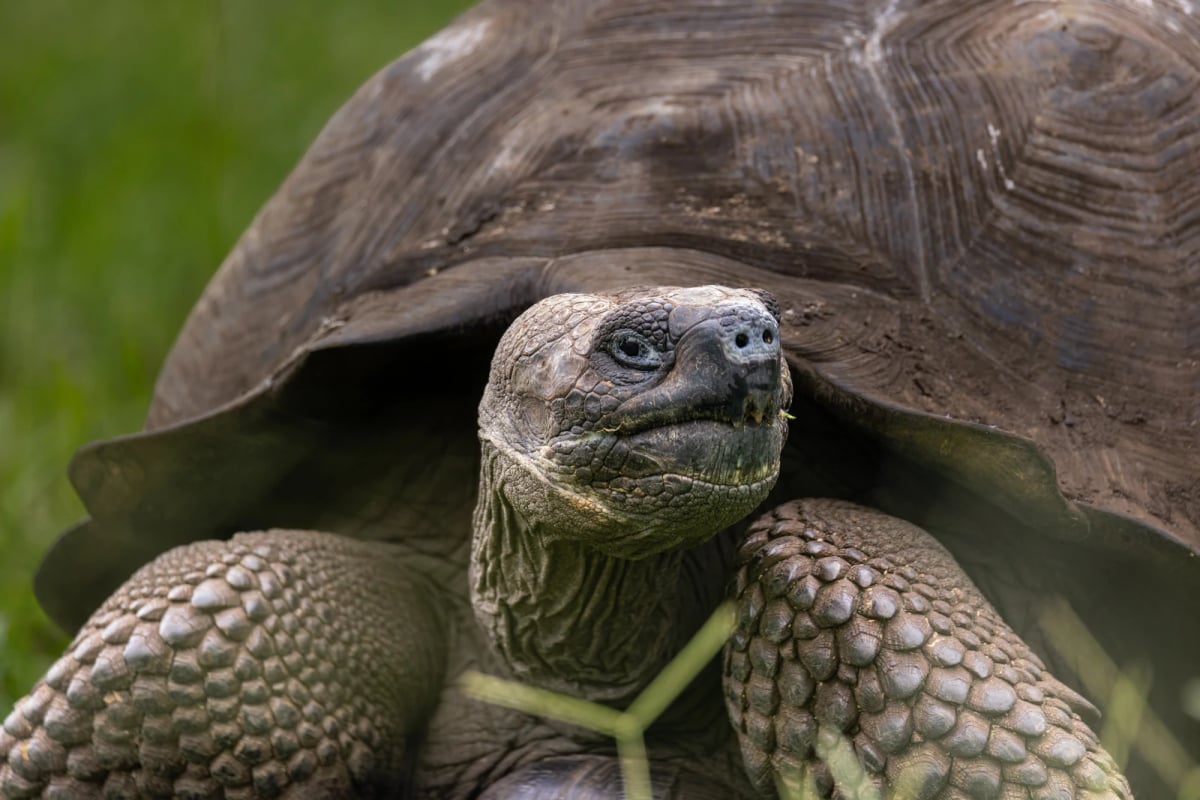
The Galápagos tortoise, or Galápagos giant tortoise, is the largest living tortoise in the world and the animal that gave the Galápagos Islands their name: galápago is an old Spanish word for tortoise. Large males can weigh well over 200 kilograms and carry a shell up to about 1.5 meters long, while females are much smaller. It is not a single animal but a group of about a dozen living species in the genus Chelonoidis, each found on its own island or volcano of the archipelago, which belongs to Ecuador and lies about 1,000 kilometers off the coast of South America. On wet, high islands the tortoises have large, rounded shells, called domed, while on dry, low islands they have saddleback shells that rise at the front so they can stretch their long necks up to reach cactus pads and shrubs. They are slow, peaceful plant eaters that graze grasses, leaves, fruits and prickly pear cactus, spend hours resting in mud pools and can go months without eating or drinking. That ability nearly destroyed them: from the seventeenth to the nineteenth century, pirates and whalers carried away more than 100,000 tortoises as live food for their ships, and later goats, rats, pigs and other animals brought by people ate their food, eggs and young. Charles Darwin studied them in 1835, and Lonesome George, the last tortoise of Pinta Island, who died in 2012, became a world symbol of extinction. Thanks to decades of breeding and the removal of invasive animals, several species are now recovering. The IUCN lists the living species as Vulnerable to Critically Endangered, and two of them are extinct.
Galápagos Tortoise: Name and Origins
The Galápagos Islands are named after their tortoises. When Spanish sailors first reached the islands in 1535, they found them crowded with huge tortoises, and galápago was an old Spanish word for a tortoise, possibly because the shell of some of them looked like a riding saddle. In English the animal is called the Galápagos tortoise or Galápagos giant tortoise, and in Ecuador people often call it simply galápago. The ancestors of these tortoises came from mainland South America. Genetic studies show that their closest living relative is the much smaller Chaco tortoise of Argentina, Paraguay and Bolivia. Between two and three million years ago, one or a few tortoises were probably carried out to sea by currents, perhaps on floating vegetation, and drifted about 1,000 kilometers until they reached the islands. Tortoises can float with their heads up and survive weeks without food or water, so the trip was possible. Once there, they spread from island to island, and each population changed over time to fit its own island. That is why the Galápagos tortoises became a famous example of evolution. When Charles Darwin visited the islands in 1835 aboard the Beagle, the vice governor told him that he could tell which island a tortoise came from just by looking at its shell. Darwin did not realize the importance of that remark at first, but the tortoises, together with the finches and mockingbirds, later helped him develop his theory of natural selection.
Galápagos Tortoise Species
For a long time the Galápagos tortoise was treated as a single species with several subspecies, under the name Chelonoidis niger. Today most scientists treat each island population as its own species, and about a dozen are still alive, although the exact count depends on how they are classified. The large island of Isabela has five, one on each of its big volcanoes: the Wolf Volcano tortoise, the Darwin Volcano tortoise, the Alcedo tortoise, which is the largest population of all, the Sierra Negra tortoise and the Cerro Azul tortoise. Santa Cruz has two: the Western Santa Cruz tortoise, Chelonoidis porteri, the domed giant most visitors see, and the Eastern Santa Cruz tortoise, Chelonoidis donfaustoi, which was described only in 2015 after genetic tests showed it was different. San Cristóbal, Santiago, Pinzón and Española each have their own species. The most mysterious is the Fernandina giant tortoise, Chelonoidis phantasticus. It was known from a single male collected in 1906 and was thought to be extinct, until a ranger expedition found an old female, named Fernanda, on Fernandina Island in 2019; in 2022 genetic tests confirmed she belonged to the same species. Other species were not so lucky. The Pinta Island tortoise died out with Lonesome George in 2012, the Floreana tortoise disappeared in the nineteenth century, and the tortoises of Santa Fe and Rábida are known only from bones. The IUCN lists the living species between Vulnerable and Critically Endangered.
Galápagos Tortoise Size and Shell Shapes
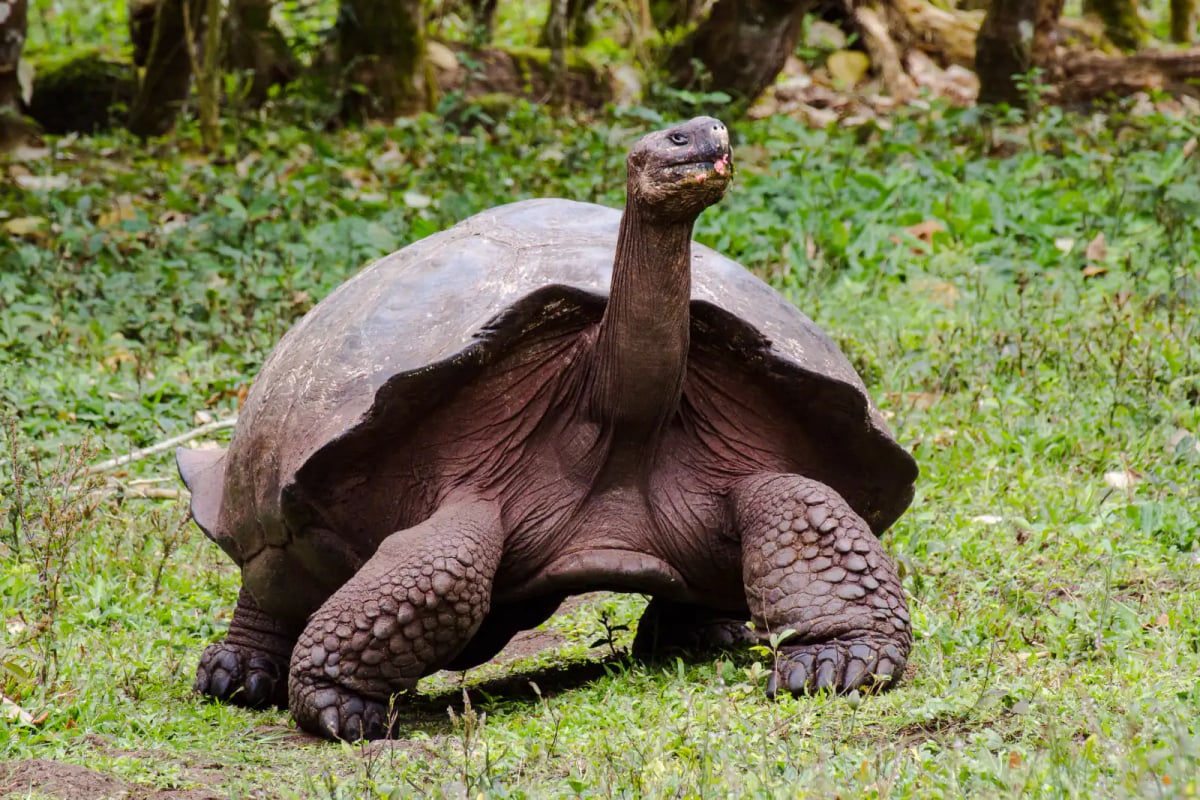
The Galápagos tortoise is the largest tortoise alive today, a little ahead of the Aldabra giant tortoise of the Indian Ocean. Large males usually weigh about 200 to 300 kilograms, and the biggest have passed 400 kilograms, mostly in captivity. Their shells can reach about 1.5 meters in length, and when a big male stretches its legs and neck, its head can rise more than a meter off the ground. Females are much smaller, often about half the weight of the males, and the size of the tortoises also changes a lot from one island to another. The shell is made of bony plates covered by large scales, called scutes, and is usually dark gray, brown or almost black. The legs are thick and columnar, like small elephant legs, and covered with hard scales, and the head and long neck have loose, wrinkled skin. The most famous difference between the species is the shape of the shell. On high, humid islands such as Santa Cruz and the big volcanoes of Isabela, where grass and low plants are easy to reach, the tortoises are large and have rounded, domed shells. On low, dry islands such as Española and Pinta, food is scarce and often hangs higher, on cactus and shrubs, and the tortoises are smaller and have saddleback shells that curve up above the neck like a saddle. That gap lets them stretch their long necks and legs upward to reach food, and males also raise their heads as high as they can when they compete. Some species have shells in between the two shapes.
Galápagos Tortoise Habitat and Migration
Galápagos tortoises live only on the Galápagos Islands, a group of volcanic islands of Ecuador that sit on the equator in the Pacific Ocean, about 1,000 kilometers west of the mainland. Today wild tortoises live on Santa Cruz, Isabela, San Cristóbal, Santiago, Pinzón, Española and Fernandina, and young tortoises have been released on Santa Fe and, since 2026, on Floreana. Their habitat ranges from the dry lowlands near the coast, covered with cactus, thorny shrubs and bare lava, to the humid highlands, where mist keeps the grass and forests green for much of the year. Many tortoises use both. On Santa Cruz, studies with GPS trackers have shown that large adults make a yearly migration. During the cool, dry season, when the lowlands are brown, they climb to the highlands, where the mist called garúa keeps plants growing. When the warm rainy season arrives, around January, they walk back down to the lowlands, where fresh plants sprout and the females lay their eggs. A trip can cover up to about 10 kilometers and take two or three weeks, often along the same paths year after year. Today many of those paths cross farms and roads, which brings tortoises into contact with people. In the hottest hours, tortoises rest in the shade or lie in mud pools and ponds, which keep them cool and help protect them from mosquitoes and ticks. At night they sleep in shallow hollows or under bushes.
Galápagos Tortoise Diet
Galápagos tortoises are herbivores. They eat grasses, leaves, vines, flowers, fruits, lichens and berries, and on the dry islands one of their most important foods is the prickly pear cactus, whose fleshy pads and fruits give them both food and water. They swallow the cactus spines along with the pads, apparently without harm. They also eat the fruit of the poison apple tree, or manchineel, which is toxic to people, and many introduced plants, such as guava and passion fruit, which have spread across the farmland of the highlands. An adult can eat a large amount of plants in a day and then go for long periods without eating at all. Tortoises have a slow metabolism and can store water in their bodies, so they can survive many months without food or water, and some sources say up to a year. That was exactly what made them so valuable to sailors. Pirates and whalers stacked live tortoises in the holds of their ships, where they stayed alive for months and gave fresh meat on long voyages. When they find water, tortoises drink a lot. They gather at rain pools and lagoons in the highlands, push their heads under the surface and drink for long periods. The tortoises also play a big role in their islands. They spread the seeds of many plants in their droppings, often far from the parent plant, and by eating and trampling plants they keep open areas clear. Scientists call them ecosystem engineers, and their return to islands such as Española and Floreana is helping to restore the original vegetation.
Galápagos Tortoise Lifespan and Breeding
Galápagos tortoises are among the longest living animals with a backbone. In the wild they commonly live more than 100 years, and in captivity some have lived well beyond that. A tortoise named Harriet, kept at Australia Zoo, was thought to be about 175 years old when she died in 2006, although her exact age was never confirmed. They grow very slowly and do not start breeding until they are about 20 to 25 years old. Mating can happen at any time of year but is most common during the warm, rainy season. Males compete by facing each other and stretching their necks as high as they can; the one that rises higher usually wins without a fight. A mating male makes loud, deep grunts that can be heard from far away. Between about June and December, females walk down to dry, sandy areas in the lowlands. Each female digs a hole with her back legs, wets the soil with urine to make it easier to dig, lays from about 2 to 16 round, hard eggs, and covers them with a plug of mud that dries hard in the sun. She may lay several nests in one season. The eggs take about four to eight months to hatch, and the temperature of the nest decides the sex of the young: warmer nests produce mostly females and cooler nests mostly males. The hatchlings weigh only about 50 to 80 grams and must dig their way out, which can take weeks. They receive no care from their parents and spend their first years hiding in the lowlands, where they are easy prey for introduced rats, cats and pigs.
Lonesome George and the Pinta Island Tortoise
Lonesome George was the most famous tortoise in the world. Pinta, a small island in the north of the archipelago, once had its own saddleback species, the Pinta Island tortoise, Chelonoidis abingdonii. Whalers took most of them in the nineteenth century, and goats released on the island in 1959 ate almost all the plants, so for decades the species was believed to be extinct. Then, in 1971, a scientist studying snails spotted a single male tortoise on Pinta. He was taken to the Charles Darwin Research Station on Santa Cruz in 1972 and named Lonesome George, or Solitario George in Spanish, because he seemed to be the last of his kind. For 40 years, scientists searched Pinta and zoos around the world for a female of his species, without success. They placed him with females of closely related species from Wolf Volcano and Española, and two of them laid eggs, but none of the eggs hatched. George died on 24 June 2012, probably at more than 100 years of age, and with him the Pinta Island tortoise became extinct. His body was preserved by taxidermists in New York and since 2017 has been displayed at the research station in Puerto Ayora, where he lived. His story is not completely over. On Wolf Volcano, in northern Isabela, scientists have found tortoises with part Pinta ancestry, descendants of animals that sailors moved or dropped there, and some are part of breeding programs that hope to bring tortoises with Pinta genes back to the island.
Galápagos Tortoise Population and Conservation
Before people arrived, the Galápagos Islands probably held more than 200,000 giant tortoises. From the late seventeenth century, pirates, whalers and seal hunters took them by the thousands as live food, and logbooks suggest that well over 100,000 were removed in the nineteenth century alone. Settlers later hunted them for meat and oil, and the animals people brought with them did even more damage. Goats and donkeys ate the plants the tortoises needed, while rats, pigs, dogs, cats and fire ants ate their eggs and young. By the 1970s only about 15,000 tortoises were left, and several species were down to a few animals. The recovery began in 1959, when Ecuador created the Galápagos National Park, and the Charles Darwin Research Station opened soon after. Rangers collected eggs and young from the wild, raised them in breeding centers until they were large enough to survive, and released them on their home islands, while huge projects removed goats, pigs and rats from several islands. The best known success is Española. Its species was reduced to just 14 adults, 12 females and 2 males, which were taken into captivity in the 1960s and 1970s, joined in 1976 by a third male, Diego, from the San Diego Zoo. The program released more than 2,000 young tortoises, and today the population breeds on its own. In February 2026, 158 young tortoises with Floreana ancestry, bred from animals found on Wolf Volcano, were released on Floreana. Recent estimates put the total at roughly 25,000 tortoises. Poaching, invasive animals, roads and climate change remain threats.
Where to See Galápagos Tortoises
The easiest place to see wild Galápagos tortoises is the highlands of Santa Cruz, the most visited island. Private farms such as El Chato and Rancho Primicias, a short drive from Puerto Ayora, have trails and ponds where large domed tortoises graze and wallow in the mud, especially during the dry season, when they move up from the lowlands. In Puerto Ayora itself, the Fausto Llerena Breeding Center at the Charles Darwin Research Station shows young tortoises of several species and is home to the preserved body of Lonesome George. Isabela has the Arnaldo Tupiza Breeding Center near Puerto Villamil, and San Cristóbal has La Galapaguera de Cerro Colorado, a large enclosure where tortoises of that island live in natural vegetation. Visitors on boat trips can sometimes see tortoises on Española and around Urbina Bay on Isabela. Rules are strict: visitors must stay at least two meters from the tortoises, never touch or feed them, and stay on the marked trails. Tortoises often cross the roads of the Santa Cruz highlands, and drivers are asked to slow down, since several have been hit by vehicles. Outside the islands, many zoos keep Galápagos tortoises as part of breeding and education programs. Trade in the species is strictly controlled under international law, and removing a tortoise or its eggs from the islands is a crime in Ecuador.