Golden Poison Frog
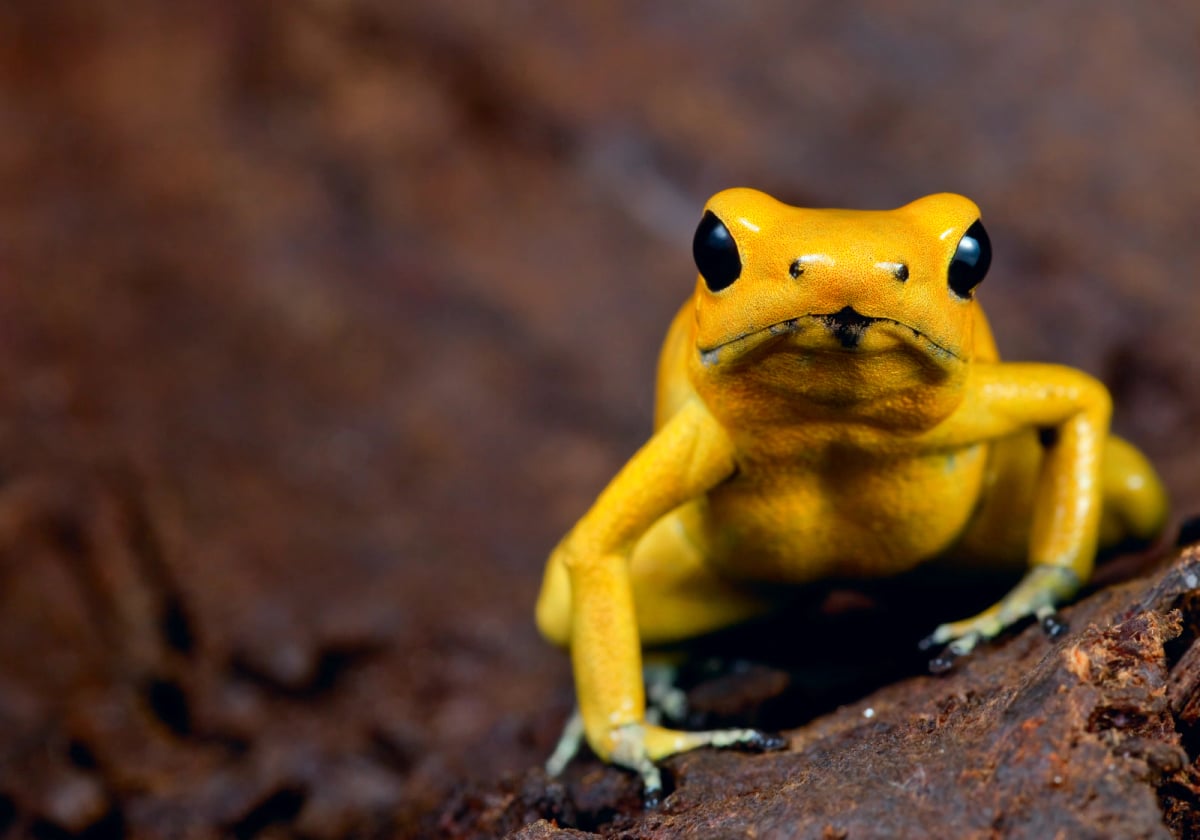
The golden poison frog (Phyllobates terribilis), also called the golden dart frog or golden poison dart frog, is considered the most poisonous frog in the world. It is a small, bright yellow frog, about 4 to 5 centimeters long, that lives only in a small area of lowland rainforest on the Pacific coast of Colombia, in the department of Cauca. Its skin is loaded with batrachotoxin, one of the most powerful natural poisons known. A single wild frog carries on average about 1 milligram of it, which scientists estimate could be enough to kill about ten people. The frog does not bite or sting; the poison stays in its skin and protects it from predators, and its bright color works as a warning. The frog does not make the poison itself. It gets the chemicals from the small insects and other invertebrates it eats in the wild, so frogs raised in captivity on a different diet are harmless. Indigenous Emberá hunters of the Colombian Pacific have long rubbed the tips of their blowgun darts on the backs of these frogs, which is where the name dart frog comes from. Golden poison frogs are active by day, live in small groups on the forest floor, and the males carry their tadpoles on their backs to small pools of water. Scientists only described the species in 1978 and named it terribilis because of its extraordinary poison. The IUCN lists the golden poison frog as Endangered, because it lives in a tiny range threatened by deforestation, illegal mining and crops, and illegal collection for the pet trade.
Golden Poison Frog: Name and Discovery
The golden poison frog belongs to the family Dendrobatidae, the poison frogs of Central and South America, a group of more than 300 small, often brightly colored frogs. Within that family it is one of only three species of the genus Phyllobates that are known to be used to poison hunting darts, together with the black legged dart frog and the Kokoe poison frog, both also from western Colombia. For centuries, the Emberá and other Indigenous peoples of the Colombian Pacific have hunted with blowguns, and to make their darts deadly they hold a frog down with a stick or a leaf and rub the dart tips across its back. The frog is usually released alive, and the darts stay poisonous for a long time. This practice gave the whole family its English names, poison dart frogs or dart frogs, although most species are never used this way. Local people call the frog kokoi, and the Eperara Siapidara community named its reserve for the frog K'õk'õi Eujã, which means land of the frog. Despite its fame today, the golden poison frog was unknown to science until the 1970s. The American scientists Charles Myers and John Daly, together with Borys Malkin, described it in 1978 from frogs collected along the Quebrada Guangüí, a stream in the Saija River basin of Cauca. They named it terribilis, Latin for terrible, because its skin held far more poison than that of any frog they had studied. In English it is also called the golden dart frog and the golden poison dart frog, and in Spanish rana dorada venenosa or rana dardo dorada.
Golden Poison Frog Size and Colors
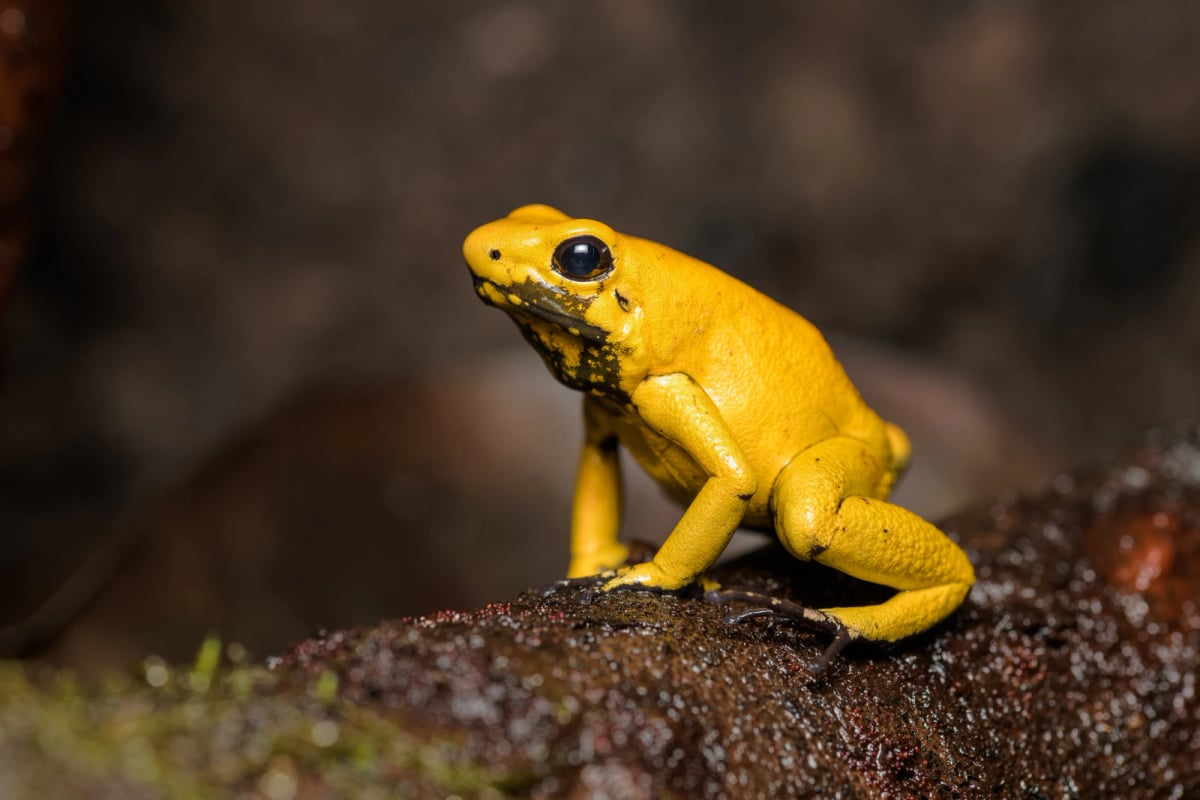
The golden poison frog is small, but it is one of the largest poison frogs. Adults usually measure about 4 to 5 centimeters from the snout to the end of the body, roughly the size of a large paper clip or the top joint of an adult thumb, and weigh about a gram. Females tend to be a little larger than males. The body is plump and solid, the skin smooth and slightly shiny, and the large dark eyes stand out against the bright color of the head. Like other poison frogs, it has no webbing between the toes, because it lives on the forest floor rather than in the water, and the tips of its fingers have small pads that help it grip wet leaves and branches. Despite the name, not all golden poison frogs are golden. The best known form is bright yellow, but in different places there are frogs that are pale mint green, deep orange or almost white. Young frogs are dark, almost black, with two golden stripes along the back, and only take on the solid adult color as they grow. This bright, uniform color is a warning, a strategy scientists call aposematism. Predators that try to eat a poison frog learn quickly, if they survive, to avoid anything that looks like it, and the frog can move around in daylight without needing to hide.
Golden Poison Frog Poison
The golden poison frog is considered the most poisonous frog on Earth, and one of the most poisonous animals of any kind. Its poison is batrachotoxin, a substance found only in a few frogs of the genus Phyllobates and, surprisingly, in some birds of New Guinea, such as the pitohuis, and the beetles they eat. Studies of wild frogs found an average of about 1.1 milligrams of batrachotoxin in the skin of each frog, and up to about 1.9 milligrams. Nobody knows the exact lethal dose for a person, but it has been estimated at about 0.2 milligrams, so a single frog could hold enough poison to kill about ten adults. Batrachotoxin works on the nerves and muscles. It keeps the sodium channels in the cell membranes permanently open, so nerves cannot stop firing and muscles, including the heart, cannot relax. The result is paralysis and heart failure, and there is no antidote. The frog does not bite, sting or spray its poison. The batrachotoxin is stored in glands in the skin and released when the frog is stressed or handled, and it is dangerous only if it enters the body through a cut, the eyes or the mouth. The frog protects itself thanks to a small change in its own sodium channels that makes them resistant to the poison. Its toxicity also depends on its food. Frogs raised in zoos and terrariums on crickets and fruit flies have little or no batrachotoxin, which suggests that wild frogs take it from small insects or other invertebrates in their habitat, still not identified.
Golden Poison Frog Habitat and Range
The golden poison frog lives only in Colombia, in a very small part of the Chocó, the band of rainforest that runs along the Pacific coast of South America and is one of the rainiest regions on the planet. It is known from the lowland forests of the department of Cauca, mainly in the basin of the Saija River and nearby rivers in the municipality of Timbiquí, where it was first found along the Quebrada Guangüí. The IUCN estimates that it is found in only one to four locations, between about 50 and 400 meters above sea level. This forest receives several meters of rain a year, the air is always warm and humid, with temperatures of around 26 degrees Celsius or more, and the ground is covered with a thick layer of fallen leaves. Golden poison frogs live on that forest floor, usually close to small streams, where they hunt among the leaf litter, the roots and the fallen branches. They climb only a short distance up trunks and plants. The frogs need humidity all the time, because like other amphibians they breathe partly through the skin and dry out easily, and they need small pools of water, such as puddles, holes in the ground or the water held in plants, for their tadpoles. Because the range is so small, the species depends completely on the survival of these few patches of forest. The region is also remote and hard to reach, with few roads and a long history of armed conflict, so scientists still know little about how many frogs are left and exactly where all the populations are.
Golden Poison Frog Diet
Golden poison frogs are small predators of the forest floor. They eat ants, termites, small beetles, flies, crickets, spiders, mites and other tiny invertebrates that live among the fallen leaves. Like other poison frogs, they hunt by sight during the day, walking slowly through the leaf litter and catching their prey with a quick flick of the sticky tongue. Their diet is not only food; it is also the source of their defense. Poison frogs do not produce their alkaloid poisons themselves but absorb them from the animals they eat and store them in the glands of the skin. In many species of dart frogs, the main sources are ants, mites and small beetles. In the case of the golden poison frog, scientists still do not know exactly which prey gives it batrachotoxin. One idea comes from New Guinea, where birds that carry the same poison get it from small beetles of the family Melyridae, and relatives of those beetles also live in Colombia. This is why the frogs lose their poison in captivity. In zoos and terrariums they eat fruit flies, small crickets and springtails, which have none of those chemicals, and after some time in captivity, or after being born there, they are almost harmless. Unlike many frogs, golden poison frogs are bold and active hunters. Thanks to their poison they have few enemies and can spend the whole day searching for food in the open. Their tadpoles feed on algae, small organisms and bits of plant and animal matter in their pools.
Golden Poison Frog Behavior and Breeding
Golden poison frogs are active during the day, unlike most frogs, which hide by day and come out at night. With almost no predators to fear, they move around in the open, often in small groups of several frogs that share a patch of forest floor. Males call to attract females and to mark their space with a long, fast trill, and they can be territorial toward other males. Only one predator is known to be able to eat young golden poison frogs regularly: a small snake of the Pacific forests, Erythrolamprus epinephelus, which has a high but not complete resistance to the frogs' toxins. The breeding behavior of golden poison frogs is typical of dart frogs and very different from that of most frogs, which lay hundreds of eggs in water and leave them. After courtship, the female lays a small clutch of eggs, usually about 8 to 20, on the ground among wet leaves, and the male fertilizes them. The eggs are guarded and kept moist, and they hatch into tadpoles after about two weeks. The male then lets the tadpoles wriggle onto his back, where they stick, and carries them to small pools of water on the ground or in plants, where they finish developing. After about two months they change into small froglets that are dark with golden stripes, and they reach adult color and size within the first year. In captivity, golden poison frogs usually live about 5 to 10 years, and some live longer. Their lifespan in the wild is not known.
Golden Poison Frog Conservation Status
The IUCN lists the golden poison frog as Endangered. Its last assessment, made in 2016, found that the species is known from only one to four locations in a very small range, and that the quality of its habitat keeps getting worse. Nobody knows how many frogs are left, and the population is believed to be decreasing. The main threat is the loss of its forest. In the Pacific lowlands of Cauca, trees are cut for timber and land is cleared for farming, often by burning. Illegal coca crops have spread into the region, and gold mining, both legal and illegal, has cleared forest along the rivers and polluted the water with mercury and mud. Armed groups that fight over coca and mining have made the area dangerous and hard to protect. The frog is also threatened by illegal collection. Its bright color and fame make it very attractive in the international trade of exotic animals, and frogs taken from the wild are smuggled abroad, even though the species is protected by Colombian law and listed in CITES, the international treaty on wildlife trade. Today, golden poison frogs bred in captivity are widely available, which takes some pressure off the wild populations. Several projects work to protect the species. The ProAves foundation created the Ranita Terribilis reserve in Timbiquí in 2008, and in 2019 the Eperara Siapidara Indigenous community created the K'õk'õi Eujã reserve, of about 11,600 hectares, to protect the frog and its forest. Many zoos keep golden poison frogs as part of breeding and education programs.