Pine Marten
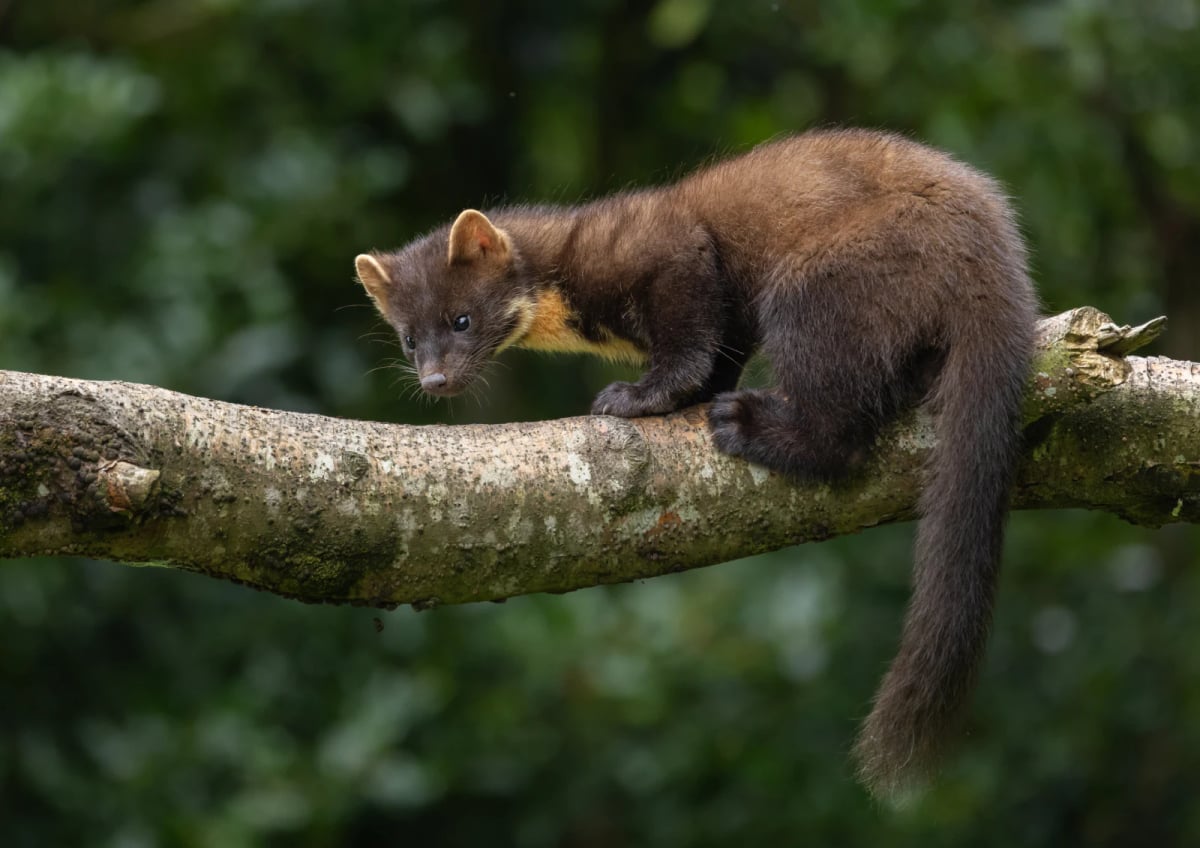
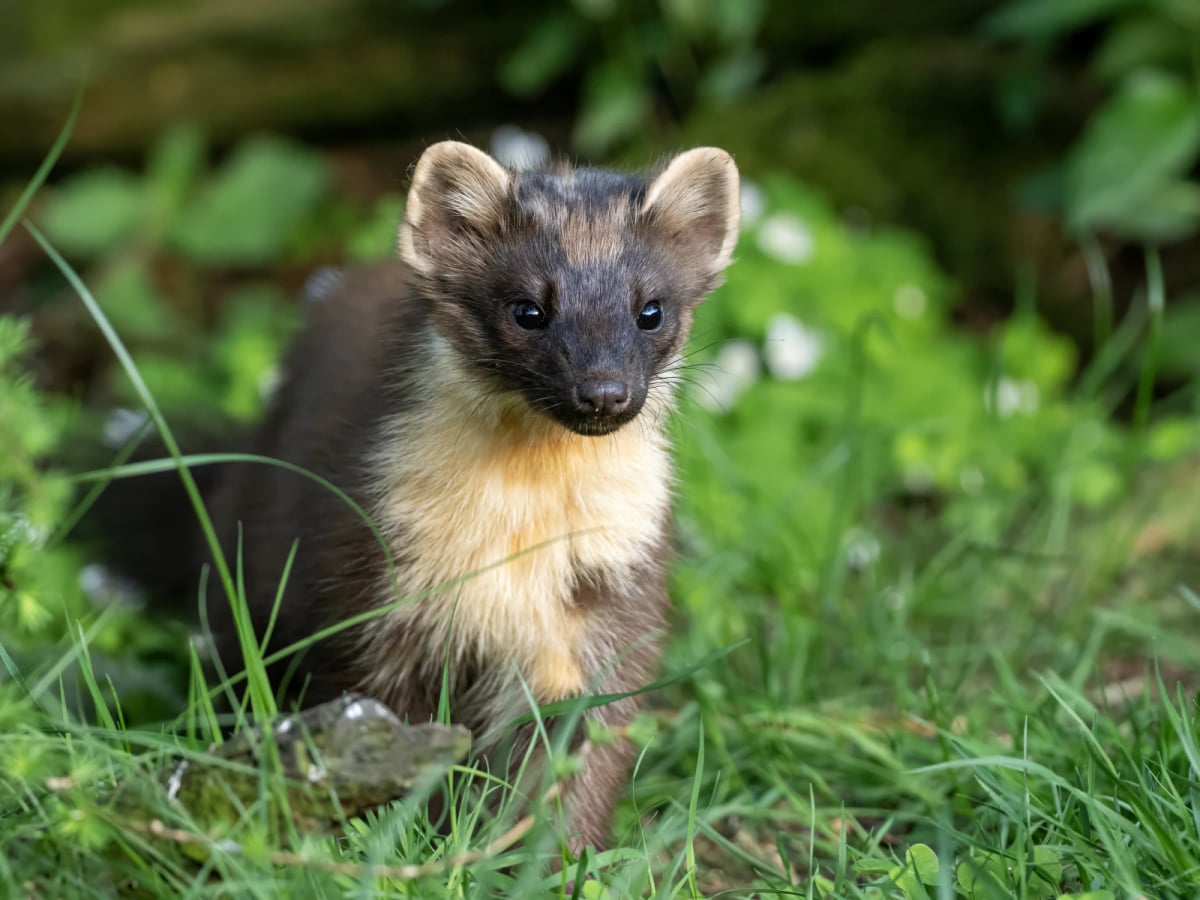
The pine marten (Martes martes), also called the European pine marten or tree marten, is a slender, agile carnivore of the weasel family that lives in the forests of Europe and western Asia, from Ireland and Scandinavia to western Siberia, the Caucasus and northern Iran. It is about the size of a small house cat but longer and much lighter, with chocolate brown fur, a long bushy tail and a creamy yellow to orange bib on the throat that ends in a rounded point. It is built for climbing, with sharp semi retractile claws, and it moves through the treetops as easily as a squirrel. Pine martens need mature woodland with old trees, fallen logs and dense cover, and they rest by day in tree holes, old squirrel nests and rock piles. They hunt mainly at night, taking voles, squirrels, birds and eggs, and from late summer on they eat a lot of berries, spreading the seeds as they go. In Britain and Ireland the species almost disappeared in the early 1900s and is now coming back. The IUCN lists it as Least Concern, with a stable population.
What is a pine marten? Names and other types of martens
The pine marten is a slender, tree climbing carnivore of the genus Martes, part of the weasel family (Mustelidae), the same family as weasels, stoats, otters, badgers and wolverines. So yes, a pine marten is a kind of weasel in the broad sense, but it is much bigger, more at home in trees and closer in size to a small house cat, with a long bushy tail, rounded ears and a pale bib on the throat. Its scientific name is Martes martes, and in English it is also called the European pine marten or tree marten, and in old texts the sweet marten, as opposed to the foul smelling polecat. In Ireland it is known as the cat crainn, the tree cat. Its closest neighbor is the stone marten (Martes foina), which shares much of Europe with it and has its own page on this site. Depending on the authority, the genus holds seven or eight species, since some scientists split the Pacific marten from the American marten. The rest are the sable of Siberia, the Japanese marten, the yellow throated marten of southern and eastern Asia, which many people call the yellow marten, and the Nilgiri marten of southern India. The fisher of North America was long counted as a marten too, but genetic studies moved it to a genus of its own, Pekania.
Pine marten vs stone marten: how to tell them apart
The pine marten and the stone marten look alike at first glance, and across much of Europe they live side by side, so the details matter. The bib is the best clue. A pine marten has a creamy yellow to orange throat patch that ends in a rounded point on the chest, as in all the photos on this page. A stone marten has a pure white bib that usually splits into two branches running down onto the front legs. The nose helps too: dark brown or black in the pine marten, paler and often pinkish in the stone marten. Pine martens also have larger ears with pale edges, slightly longer legs and, in winter, soles covered in fur, which helps on snow. Habitat is a useful hint but not proof. Pine martens stick mostly to woodland and rarely come close to buildings, while stone martens are happy on rocky ground, in farmland, villages and city suburbs, where they often sleep in attics and barns. In Ireland, Britain, Norway, Sweden and Finland only the pine marten lives in the wild, so any marten seen there is this species. Across most of Asia, from Israel to Mongolia, it is the other way around and only the stone marten occurs.
Where do pine martens live?
The pine marten is a forest animal of Europe and western Asia. Its range runs from Ireland, Britain and Scandinavia east through the great forests of Russia, beyond the Urals into western Siberia, roughly as far as the Ob and Irtysh rivers, and south to northern Spain and Portugal, Italy, the Balkans, the Black Sea coast of Turkey, the Caucasus and the Caspian forests of northern Iran. It is also found on Sardinia, Sicily and Corsica, and on Mallorca and Menorca, where the IUCN considers it introduced by people long ago. On the Mediterranean islands, where the stone marten is missing, it lives not only in woodland but also in scrub and rocky ground. Everywhere else it needs real forest: broadleaf, conifer or mixed woods with old trees full of holes, fallen logs, dense undergrowth and plenty of rodents and squirrels. The IUCN records it up to about 2,300 meters in mountain forests. It avoids open country, and wide fields or treeless land can stop it from spreading. That is why it does well in the large forests of Scandinavia, the Baltic countries, Belarus, Poland and the Carpathians, and why it is scarcer in farmland regions of western Europe, where woods are small and scattered.
How big is a pine marten? Size, weight and fur
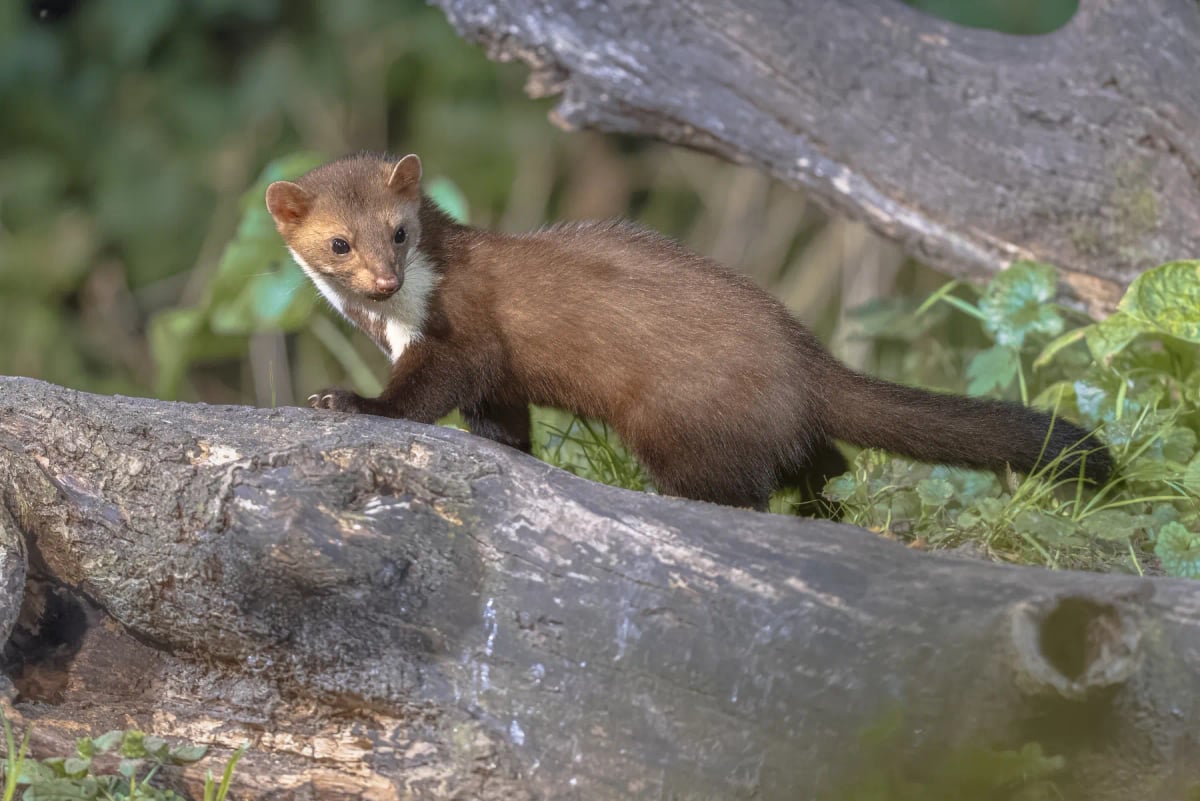
A pine marten is about the size of a small house cat, but longer, lower and much lighter. It measures roughly 45 to 58 centimeters from nose to the base of the tail, with a bushy tail of 16 to 28 centimeters, and adults usually weigh 0.8 to 2.2 kilograms. Males are clearly bigger than females, often by around a third, so a large male may weigh twice as much as a small female. The fur is chocolate brown to dark brown, darker on the legs and tail, with a creamy yellow to orange bib on the throat and chest. In winter the coat grows thicker, longer and silkier, and the soles of the feet are covered in fur. That soft, glossy winter pelt made the pine marten one of the most valued furs in medieval Europe, more prized than the coarser coat of the stone marten. The body is long and supple, the legs short, and the sharp semi retractile claws make it an excellent climber that moves along trunks and branches with ease. The long tail works as a counterweight when it runs along branches or jumps between trees. Its eyes are large and dark, suited to moving at night, and its rounded ears, edged in pale fur, stand up clearly from the head.
What do pine martens eat? Voles, berries and squirrels
Pine martens are opportunists that eat whatever is easiest to find in each season. Small rodents, especially field voles and bank voles, are the base of the diet for most of the year, and in northern forests the number of voles can decide how many young martens survive. On top of that they take squirrels, birds and their eggs, rabbits, frogs, beetles, wasp grubs, earthworms and carrion, and in winter they may follow the tracks of prey under the snow. Fruit is a big part of the menu from late summer into winter: rowan berries, bilberries, blackberries and wild cherries, plus honey when they break into a wild bees' nest. Seeds pass through the gut intact and are dropped far from the parent plant, so pine martens work as seed dispersers. The pine marten has become famous in Ireland and Scotland because studies there found that grey squirrels decline where martens recover. The grey squirrel, introduced from North America, spends more time on the ground and is heavier and easier to catch, while the native red squirrel, which evolved alongside the marten, is lighter and better at escaping through thin branches. Where pine martens return, red squirrels often come back too.
How do pine martens live? Territory, dens and kits
Pine martens are solitary and mostly active at night or around dawn and dusk, although they are often out in daylight in summer, when nights are short and mothers have kits to feed. Each adult holds a home range that it marks with scent from glands under the tail, on the belly and on the feet, and with droppings left in prominent spots such as forest tracks, rocks and logs. The ranges of males are larger than those of females and often overlap several of them. By day, pine martens rest in tree holes, old squirrel nests, bird nests, rock piles and, more and more in Britain and Ireland, in purpose built nest boxes. Mating happens in summer, mostly in July and August, and the species has an unusual trick: the fertilized egg stays dormant in the womb for several months before it implants, so the whole pregnancy lasts around eight to nine months even though the embryo only grows for about a month. The kits, usually two to four, are born blind and nearly hairless in March or April, often in a high tree hole. They leave the den at around two months old, become independent by late summer or autumn and usually breed for the first time in their second or third year.
Pine martens in Britain and Ireland: the comeback
By the early 1900s, trapping for fur, gamekeeping and the loss of woodland had wiped the pine marten out of most of Britain and Ireland. In Britain it held on mainly in the northwest Highlands of Scotland, with tiny remnants in northern England and Wales, and in Ireland it survived in a few pockets, mostly in the west. Legal protection changed the story. In Scotland, a survey based estimate from around 2013 put the population at roughly 2,600 to 3,500 adults, and the species has kept spreading south since then. In Ireland, the 2019 national survey found pine martens across much of the island again, and research there and in Scotland linked their return to falling grey squirrel numbers and recovering red squirrels. England and Wales needed help. The Vincent Wildlife Trust moved pine martens from Scotland to mid Wales between 2015 and 2017, and more were released in the Forest of Dean from 2019, on Dartmoor in 2024 and on Exmoor in 2025, when 19 animals were set free. England still has only a small population, so pine martens there remain a rare sight. Most people who want to see one go to wildlife hides in Scotland or Ireland that put out food at dusk.
Is the pine marten endangered?
No. The pine marten is listed as Least Concern on the IUCN Red List, in an assessment carried out in 2015 and published in 2016, and the IUCN describes its population as stable. There is no global head count, because martens are hard to survey, but the species lives across a huge area, from Portugal and Ireland to western Siberia, and it is common in the large forests of Scandinavia, the Baltic countries, Russia and the Carpathians. The IUCN has marked the assessment as needing an update. The picture is less comfortable at a local level. The pine marten is still scarce in England, Belgium and parts of Italy, where some researchers think competition with the more adaptable stone marten keeps it in decline. Road traffic is a leading cause of death in western Europe, especially for young animals looking for a territory of their own, and the fragmentation of forests keeps populations apart. Legal trapping for fur continues in Russia, Finland and some other countries, and illegal killing still happens where martens take game birds or poultry. Protecting old forests with hollow trees, building wildlife crossings over roads and putting up nest boxes are among the measures that help.
Where it is found
The Pine Marten can be found in places such as: