Elk
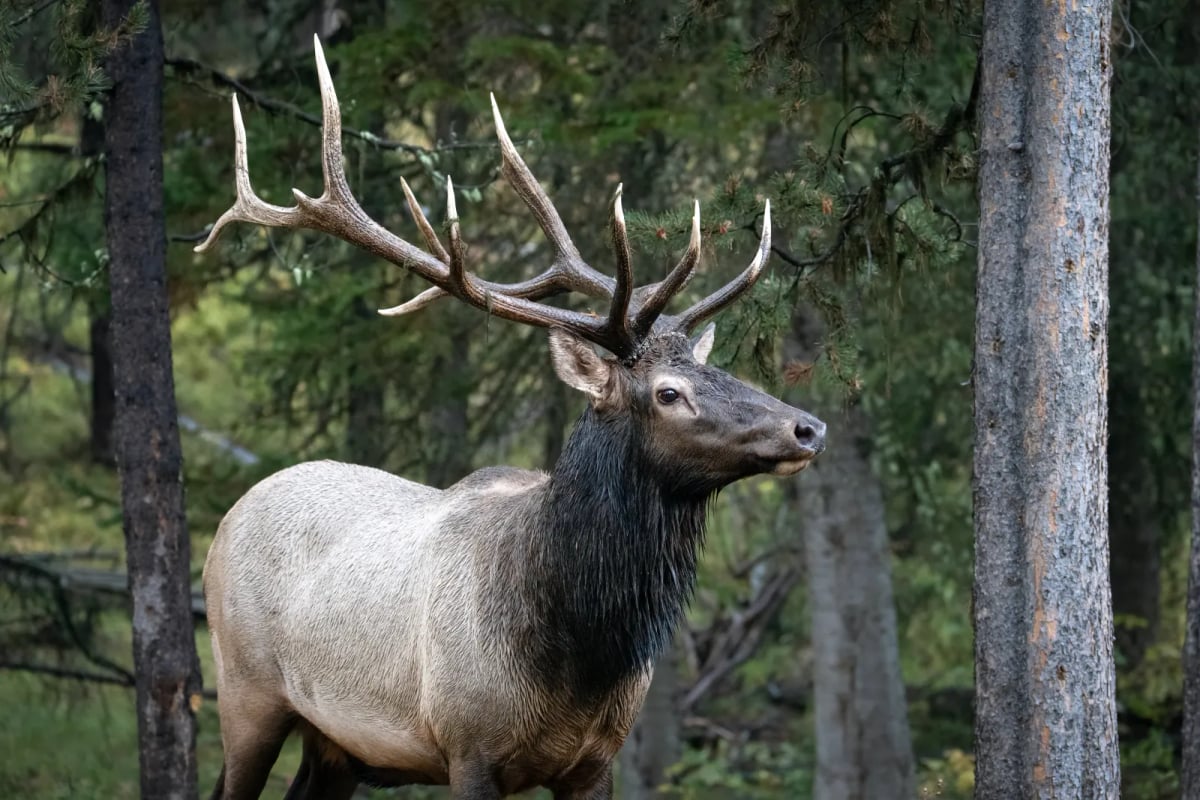
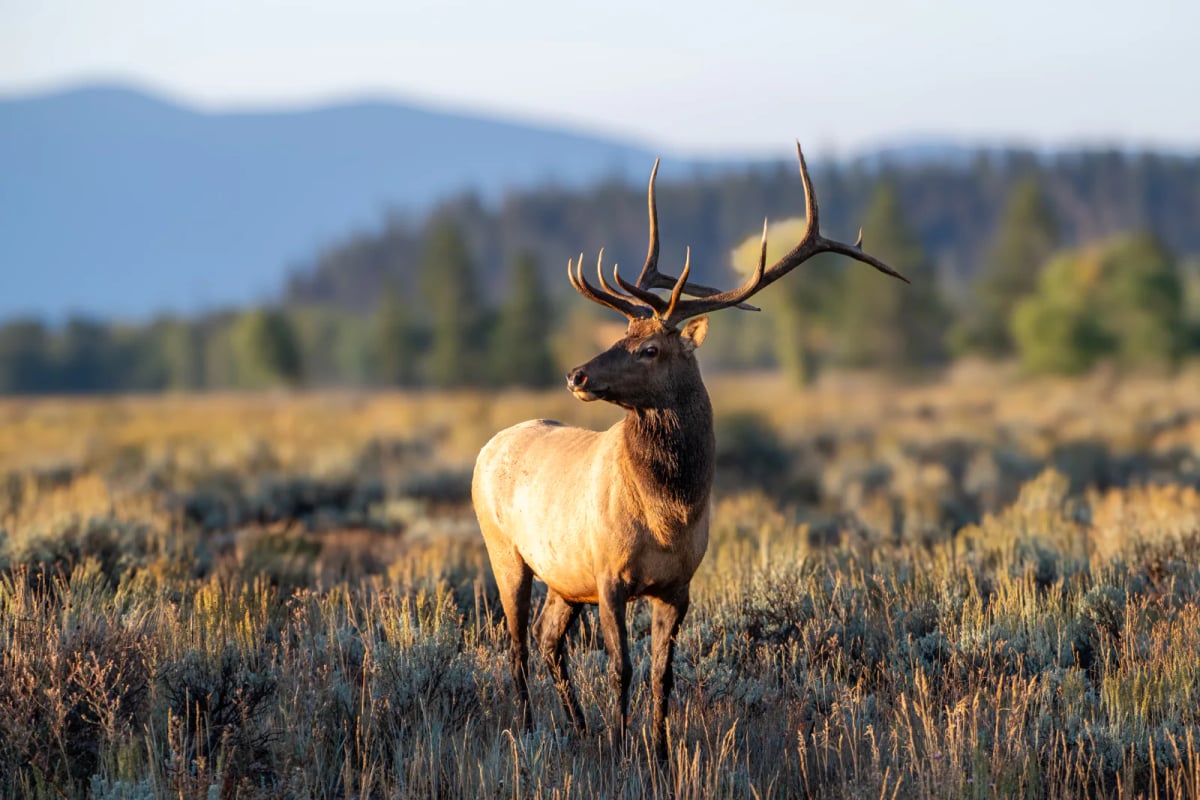
The elk, also called wapiti, is one of the largest deer in the world, second only to the moose. It lives in the forests, mountain meadows and grasslands of North America and of Central and East Asia, from the Rocky Mountains and Yellowstone to the Altai, the Tian Shan and the forests of Manchuria. A big bull weighs about 320 kilograms and stands about 1.5 meters at the shoulder, and the heaviest bulls can pass 450 kilograms. Its coat is light brown on the body, with a dark brown neck and mane and a pale yellowish patch on the rump. Every spring the bulls grow a new set of branched antlers that can spread more than a meter wide, and they shed them again at the end of winter. In autumn the bulls gather groups of cows and fill the valleys with their bugle, a high whistling call that is one of the best known sounds of the American West. Elk eat grasses, wildflowers, shrubs and the bark and shoots of trees, and they often travel long distances between summer and winter ranges. For a long time the elk was treated as a kind of red deer, but genetic studies have shown that it is a separate species, Cervus canadensis. In North America it was hunted almost to extinction by the early twentieth century, and two of its forms, the eastern elk and Merriam's elk, disappeared for good. Protection, careful hunting rules and many reintroductions brought it back, and today there are about one million elk in North America. The IUCN lists the elk as Least Concern, with a growing population.
Elk or Wapiti: Name and Classification
The name elk causes a lot of confusion. In Europe, elk is the English name of the moose, Alces alces, and that is still its meaning in Britain, Norway and Sweden, which is why people search for a Norwegian or European elk and find a moose. When English settlers reached North America, they gave the name elk to a different animal: a huge deer with branched antlers that reminded them of the red deer of Europe. To avoid the mix up, many scientists and Canadians prefer the name wapiti, which comes from a Shawnee and Cree word meaning white rump, for the pale patch on its back end. The Irish elk, another famous name, was neither: it was the giant deer, an extinct species of Ice Age Europe. For more than a century the elk was treated as a subspecies of the red deer, and the two can still produce hybrids. Genetic studies in the late 1990s and early 2000s showed that they belong to different branches of the deer family, and today most experts, including the IUCN, treat the elk as its own species, Cervus canadensis. In North America there are four living forms: the Rocky Mountain elk, by far the most common, the Roosevelt elk of the rainy Pacific coast, the small tule elk of California and the Manitoban elk of the Canadian prairies. In Asia the species includes the Altai maral and the Tian Shan maral of Central Asia, the Manchurian wapiti, known in Russia as izubr, the Alashan wapiti of northern China and the rare shou of southern Tibet.
Elk Size and Appearance
The elk is one of the largest deer on Earth. Only the moose is bigger, and the two are easy to tell apart: the moose is dark, long legged and humped, with a long drooping nose and flat antlers, while the elk is lighter in color, more graceful and has round branched antlers. A grown bull usually weighs about 320 kilograms, stands about 1.5 meters at the shoulder and measures 2 to 2.5 meters from nose to tail. Cows are smaller, at about 225 kilograms. Size changes from place to place. The Roosevelt elk of the Pacific Northwest is the heaviest, and its biggest bulls can pass 450 kilograms, while the tule elk of California is the smallest, with bulls often under 250 kilograms. In summer the coat is a warm reddish tan, short and sleek. In autumn it becomes thicker and paler, almost cream on the body, while the head, neck and legs stay dark brown, and the bulls grow a shaggy mane on the throat. The large pale rump patch, outlined in dark fur, can be seen from far away and helps a herd keep together when it runs. The tail is short. Elk also have a feature found in few other deer: two small rounded upper canine teeth, known as elk ivories or elk teeth. They are what is left of the tusks of their ancestors, and both bulls and cows have them. Calves are born with a spotted coat that helps them hide, and they lose the spots by the end of their first summer.
Elk Antlers
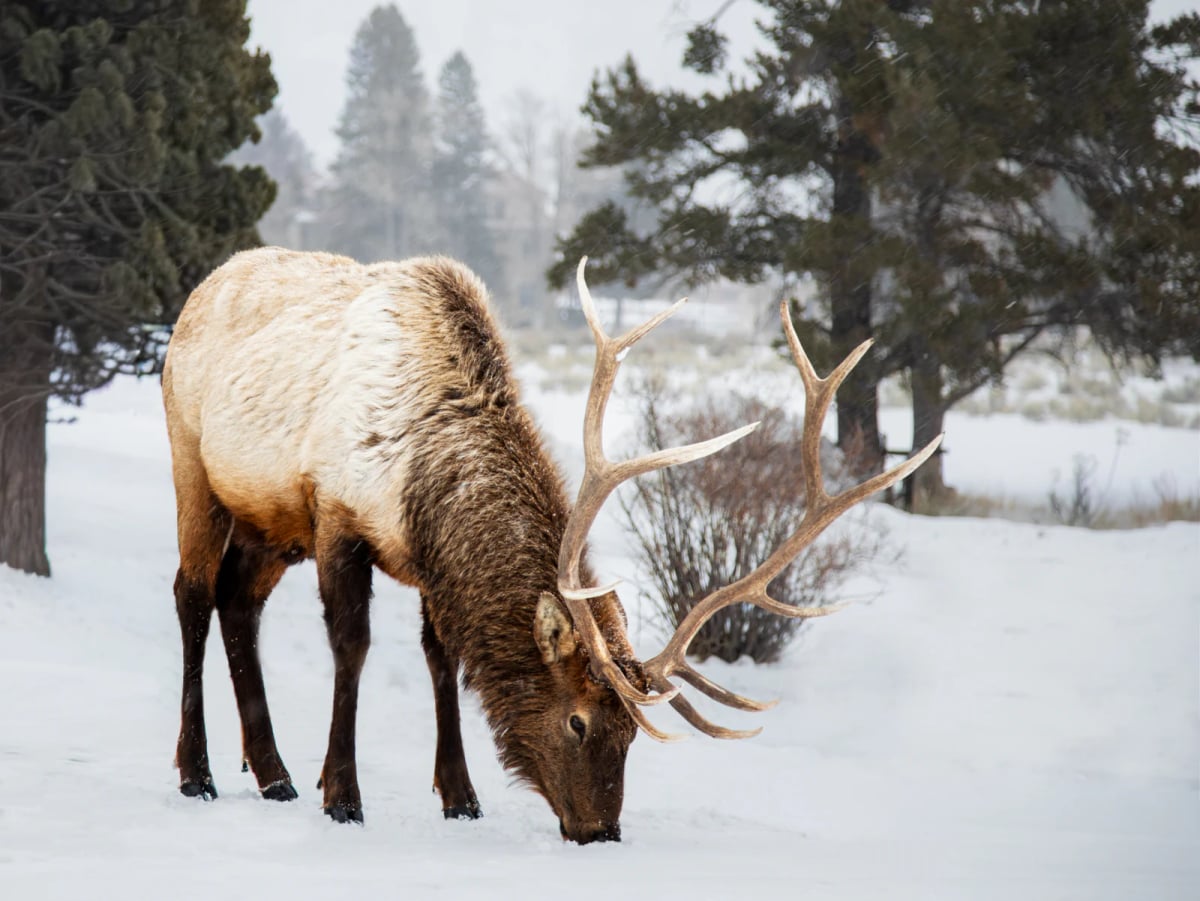
Only bull elk grow antlers, and they grow a completely new set every year. The old antlers fall off in late winter or early spring, usually between February and April, and within a few weeks new ones start to grow from two bony bases on the skull. During spring and summer the growing antlers are covered in velvet, a soft, furry skin full of blood vessels that carries food to the bone. They are among the fastest growing tissues of any animal and can lengthen by about 2.5 centimeters a day. By late summer the antlers are full size and hard. The velvet dies and the bulls rub it off against trees and shrubs, often leaving the bark stripped and the antlers stained dark. A mature bull's antlers usually have six points on each side, a set that hunters call a six by six or a royal, and they can spread more than 1.2 meters wide and weigh around 15 to 18 kilograms as a pair. Young bulls start with simple spikes, and the antlers get bigger each year until the bull is in its prime, at about 7 to 10 years old. Food quality, age and genes all affect their size. Bulls use their antlers to show off to rivals and to cows, and to fight during the autumn rut, when two bulls lock antlers and push each other back and forth. Shed antlers are an important source of minerals for rodents and other animals that gnaw them on the forest floor. In Russia, China, Kazakhstan and New Zealand, elk are also kept on farms to cut the antlers while they are still in velvet, which are sold for traditional medicine in East Asia.
Elk Habitat and Range
Elk live where forest and open ground meet. They feed in meadows, grasslands and clearings and use the forest for shelter, shade and hiding calves, from sea level on the Pacific coast to high alpine meadows above the tree line. In North America their stronghold is the Rocky Mountains, from Colorado, home to close to 300,000 elk, to Wyoming, Montana and Idaho and north into Alberta and British Columbia. Yellowstone National Park holds about 10,000 to 20,000 elk in summer, and famous herds also live in Rocky Mountain, Grand Teton, Banff and Jasper national parks. Roosevelt elk live in the rainforests of Washington, Oregon and northern California, and tule elk in the valleys and coastal hills of California. Thanks to reintroductions, elk have also returned to parts of the east, such as Kentucky, Pennsylvania and the Great Smoky Mountains. In Asia the species lives in mountain forests from the Tian Shan of Kyrgyzstan, Kazakhstan and western China to the Altai and Sayan mountains, the forests around Lake Baikal, northern Mongolia, Manchuria and the Russian Far East. Elk were introduced to New Zealand, where a herd lives in Fiordland. Many elk are migratory. Each spring they follow the new grass up the mountains, and when the snow comes they move down to lower valleys, sometimes traveling more than 100 kilometers. The herd that winters on the National Elk Refuge in Jackson, Wyoming, is one of the best known, and every spring it walks back to summer ranges in the mountains of Grand Teton and Yellowstone.
Elk Diet and Predators
Elk are herbivores, and they are more flexible than most deer. In spring and summer they are mainly grazers that eat grasses, sedges and wildflowers in open meadows. In autumn and winter, when the grass dries out or lies under snow, they switch to browsing on the twigs, buds and leaves of shrubs and trees such as willow, aspen, serviceberry and sagebrush, and they strip the bark of aspens with their lower front teeth. They dig through the snow with their hooves to reach the grass beneath. An adult elk eats around 9 kilograms of plants a day. Like cattle, elk are ruminants: they swallow their food quickly, then rest in a safe place and chew it again as cud, letting the microbes in their four chambered stomach break down the tough plant fibers. They also visit natural salt licks to get minerals. In some places, such as the National Elk Refuge in Wyoming, elk are fed in winter, a practice that keeps them away from ranches but crowds them together and helps diseases spread. Elk are an important food for large predators. Gray wolves, cougars, grizzly bears and black bears hunt them, and coyotes and bears often take young calves in their first weeks of life. In Asia, Siberian tigers and wolves hunt them too. In Yellowstone, the return of wolves in 1995 changed how elk move and feed, keeping them more alert and less likely to stay for long in river valleys, and many studies have looked at how that change has affected willows and aspens.
Elk Rut, Bugle and Calves
For most of the year elk live in herds split by sex. Cows, calves and young bulls stay together in groups that can number in the hundreds in winter, while adult bulls live alone or in small bachelor groups. Everything changes in September and October, during the rut, the breeding season. Bulls move in with the cows and try to gather a harem, a group that can include around 20 cows, and defend it day and night against rivals. Their best known weapon is the bugle, a loud call that starts as a deep roar, rises into a high whistle and ends in a series of grunts. It can be heard several kilometers away, tells other bulls how strong the caller is and draws cows. Bulls also wallow in mud soaked with their own urine, thrash shrubs with their antlers and spar. When neither bull backs down, the fight can be violent, and some end with broken antlers or serious wounds. After eight months of pregnancy, cows give birth in late May or June to a single calf, rarely twins. The calf weighs about 15 kilograms and can stand within an hour. For the first two or three weeks it lies hidden in tall grass or shrubs while the mother feeds nearby, and its spotted coat and almost total lack of smell keep it safe from predators. Then mother and calf rejoin the herd. Elk can run at up to about 65 kilometers per hour and are strong swimmers. In the wild they usually live 10 to 13 years, and in captivity up to about 20.
Elk Population and Conservation Status
The IUCN lists the elk as Least Concern, with an increasing population. Its last assessment was made in 2015 and published in 2018. That good news hides a dramatic history. Before European settlement, perhaps 10 million elk lived across much of North America, from the eastern forests to California and northern Mexico. Market hunting, the spread of farms and ranches and the loss of habitat wiped them out across most of that range, and by the early twentieth century fewer than about 100,000 remained, mostly in the Rocky Mountains. The eastern elk was declared extinct in the late nineteenth century, Merriam's elk of Arizona, New Mexico and Mexico disappeared in the early 1900s, and the tule elk of California fell to just a handful of animals before a rancher protected the last ones in the 1870s. Hunting limits, new refuges and the moving of elk from Yellowstone and other places to empty ranges brought the species back. Today there are about one million elk in North America. Kentucky released 1,541 elk between 1997 and 2002 and now has the largest herd east of the Rocky Mountains, Pennsylvania has more than 1,000, and the tule elk has grown to about 5,700 in 22 herds. Elk are also one of the most popular big game animals in North America, and hunting licenses help pay for their management. The main problems today are chronic wasting disease, roads and fences that block migration routes, and the loss of winter range to housing. In Asia, poaching for velvet antlers has hit some populations hard, and the Tian Shan maral is listed as Endangered in the national Red Book of Kyrgyzstan.
Where it is found
The Elk can be found in places such as: