Dik Dik
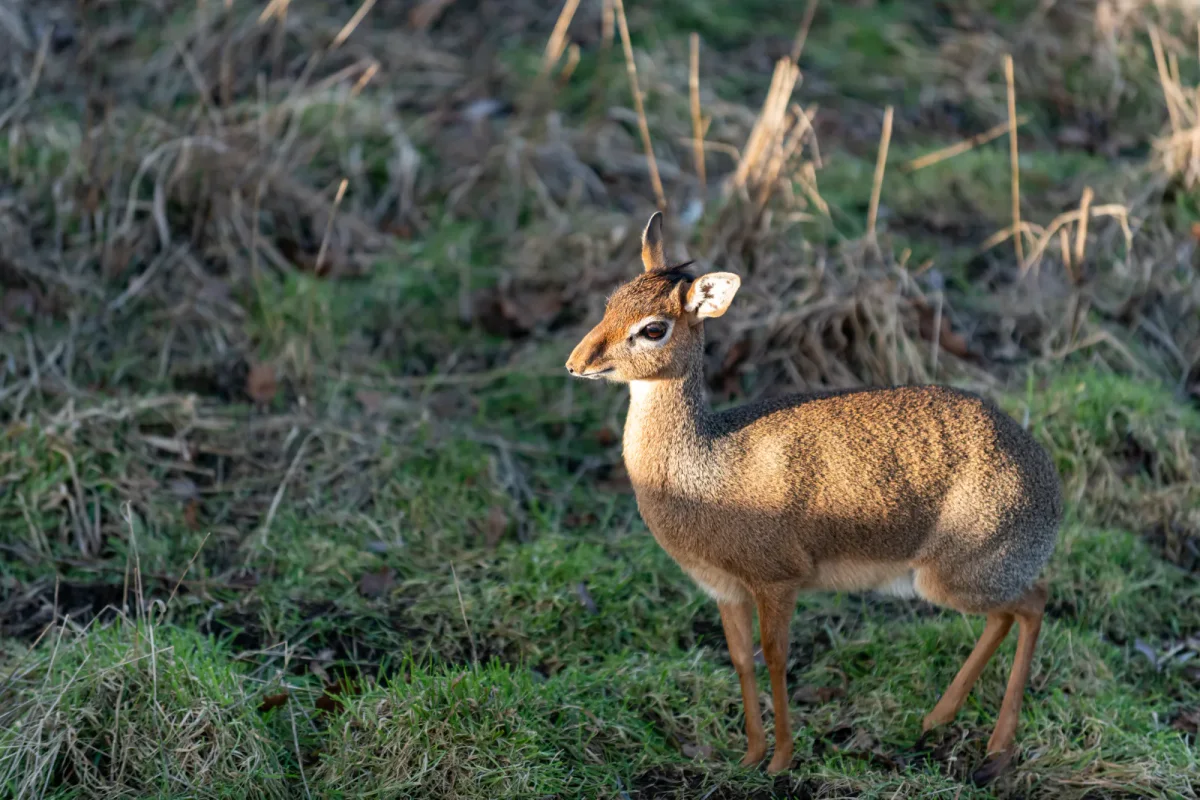
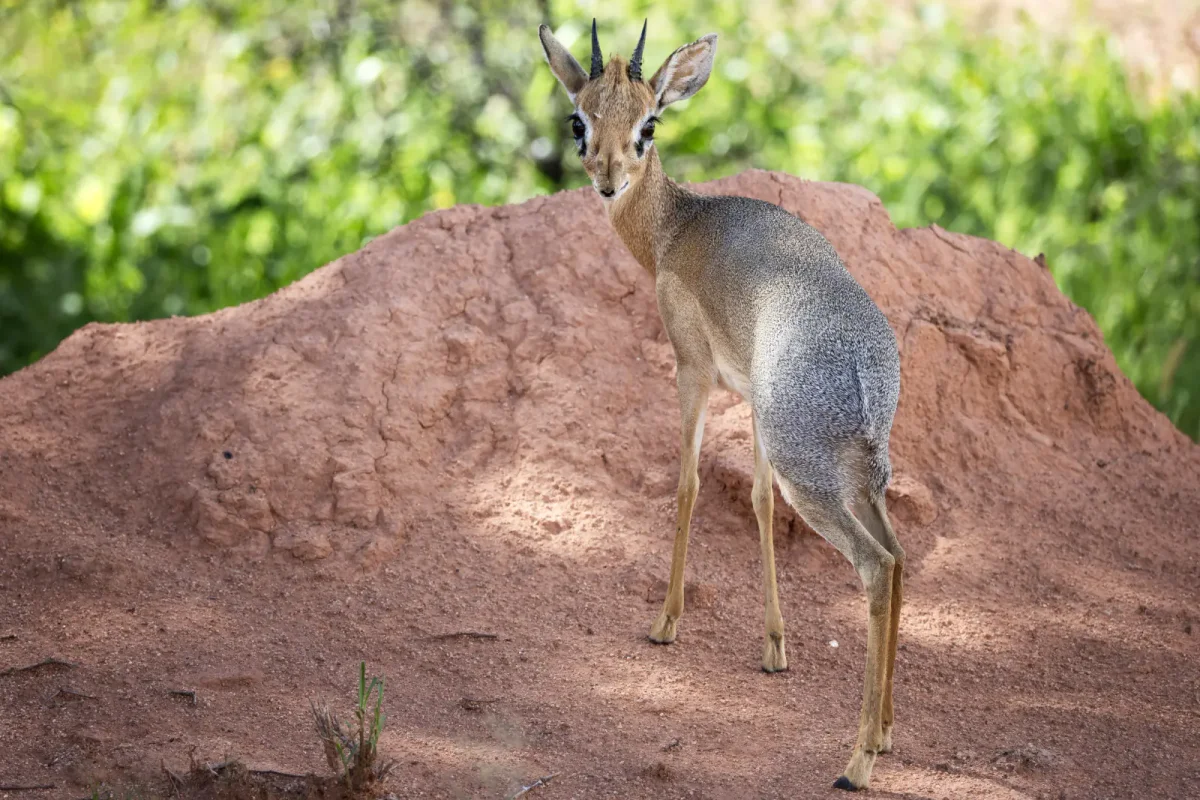
The dik dik is one of the smallest antelopes in Africa, and this page is about the best known of the four species, Kirk's dik dik (Madoqua kirkii). An adult stands only 35 to 45 centimeters at the shoulder and weighs about 4 to 7 kilograms, so it is not much taller than a house cat. It has a gray brown coat with reddish legs, large eyes ringed with white, big ears, a tuft of hair on top of the head and a long, soft nose that it can move a little, like a tiny trunk. Only the males have horns, short and sharp, often half hidden by the tuft. Its name copies the whistling alarm call it makes when it runs off. Kirk's dik dik lives in two areas far apart: the dry bush of Kenya and Tanzania in East Africa, and the north of Namibia and the southwest of Angola. It needs thickets with plenty of low cover, where it hides from predators. It eats leaves, shoots, flowers and fruit and gets almost all the water it needs from food and dew, so it can live in places with no water to drink. Dik diks live in pairs that share a territory for years, marking its borders with dung piles and a dark scent from the glands in front of their eyes. Eagles, jackals, leopards, caracals and pythons all hunt them. The IUCN lists Kirk's dik dik as Least Concern, with a stable population.
What Is a Dik Dik?
The dik dik is a dwarf antelope, a member of the same family as cattle, goats and gazelles, even though it looks more like a small deer. There are four species, all in the genus Madoqua and all from the dry lands of Africa. Kirk's dik dik is the most widespread and the one most visitors see on safari in Kenya, Tanzania and Namibia, and it is the species shown on this page. Günther's dik dik lives farther north, from northern Kenya to Ethiopia, Uganda and Somalia, Salt's dik dik lives in the Horn of Africa, and the silver dik dik is a little known species from Somalia and Ethiopia. The name comes from the sound the animal makes when it is scared: a sharp whistle through the nose that people heard as dik dik, which it gives as it runs off and which warns other animals nearby. The species is named after John Kirk, a Scottish doctor and naturalist who traveled with David Livingstone and later worked in Zanzibar. Kirk's dik dik has several local forms, and some experts now treat them as separate species. The best known is the Damara dik dik of Namibia and Angola, which lives far from the East African populations, but the IUCN still keeps them all under a single species.
Dik Dik Size and Appearance
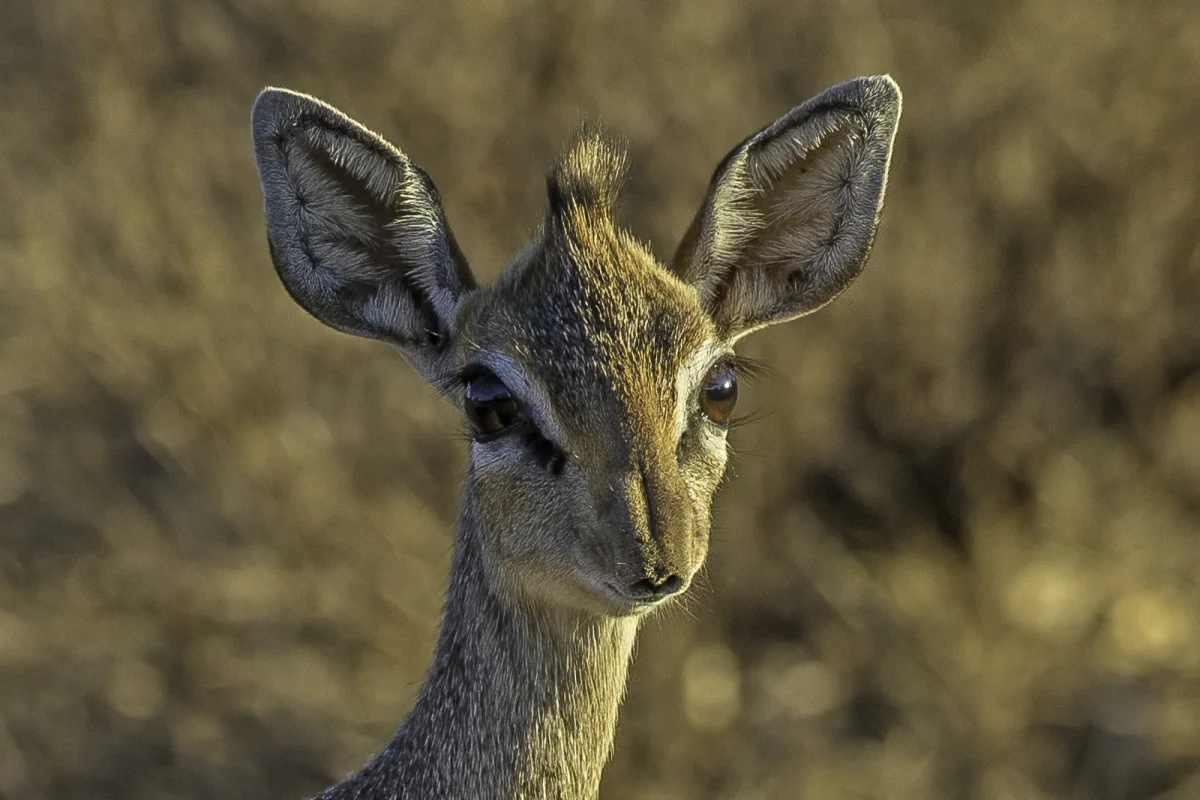
Kirk's dik dik is the largest of the four species, and it is still tiny. An adult stands 35 to 45 centimeters at the shoulder and weighs about 4 to 7 kilograms, and unlike most antelopes the females are slightly heavier than the males. The body is rounded at the back, the legs are long and thin and the hooves are very small. The coat is soft and grizzled gray brown on the back, paler underneath and reddish on the legs and face. Large dark eyes are circled by a ring of white fur, and in front of each eye there is a black spot, the opening of a scent gland. On top of the head grows a tuft of hair that the animal raises when it is excited or alarmed. Only the males have horns, about 8 centimeters long, ridged and pointing backward, and the tuft often hides part of them. The most unusual feature is the nose. The snout is long and soft and the dik dik can move it in different directions. It works as a cooling system: when the day is very hot, the dik dik pants through its nose, and the air that passes over the moist lining cools the blood before it reaches the brain.
Dik Dik Habitat and Range
Kirk's dik dik lives in two regions of Africa that are far apart, with no dik diks of this species in between. The larger one is in East Africa, across much of Kenya and the north and center of Tanzania, where it is a common sight in parks such as Samburu, Tsavo, the Serengeti and Tarangire. The second is in the southwest of the continent, in the north and northwest of Namibia and the southwest of Angola. In Namibia the best known place to see it is Etosha National Park, where a short gravel loop near Namutoni camp is even called the Dik Dik Drive. In Angola it has been recorded in recent camera trap surveys in Iona National Park, in the dry far southwest. In both regions the dik dik needs the same thing: dense, low cover. It lives in dry bush, thickets of acacia and other thorny shrubs, the edges of dry riverbeds and rocky hills with scrub, usually below 2,000 meters. It avoids open grassland, where it would have nowhere to hide, and tall forest. Because it gets its water from plants, it does not need rivers or water holes, and it can live in places that are too dry for most other antelopes.
Dik Dik Diet
The dik dik is a browser, which means it eats mostly the leaves of shrubs and low trees rather than grass. It is a very selective feeder: with its narrow, pointed snout it picks the most nutritious parts of each plant, such as young leaves, fresh shoots, flowers, fruit and seed pods, and leaves behind the tough stems. Herbs and a little green grass complete the diet after the rains. Because it is so small, it feeds close to the ground, on the lower branches of shrubs and on fallen leaves, flowers and fruit. It feeds in short sessions through the day and night, with the busiest hours at dawn and dusk. Water is the dik dik's great advantage in dry country. It almost never needs to drink, because it gets nearly all its water from the plants it eats and from the dew on the leaves in the early morning. Its body also saves water in several ways: it rests in the shade during the hottest hours and it cools its blood by panting through the nose, which loses far less water than sweating, and it is most active in the cooler hours of the night and early morning. Thanks to all this, a dik dik can go for months without drinking.
Dik Dik Pairs, Territory and Fawns
Dik diks live in pairs, a male and a female that share a territory and often stay together for life. A territory can cover from about 1 to 35 hectares, depending on how much food and cover it has, and the pair defends it all year against other dik diks. They mark it in two ways. The first is with the dark, sticky scent from the glands in front of their eyes, which they press onto grass stems and twigs; the male does this much more often than the female. The second is with dung piles called middens, placed along the borders. Marking the midden is a small ritual: the female goes first, and the male then sniffs her deposit, scrapes the ground and leaves his own dung and urine on top. Neighboring pairs add to the middens on their side of the border. A female has one fawn at a time after a pregnancy of about five and a half to six months, and she can give birth twice a year. The newborn spends its first weeks lying hidden in thick cover, and the mother comes back to nurse it. Young dik diks grow fast and reach adult size at about seven months. Soon after, the parents push them out of the territory, and they have to find a partner and a territory of their own.
Dik Dik Conservation Status
The IUCN lists Kirk's dik dik as Least Concern. Its latest assessment, from January 2016, describes a stable population that occurs in many protected areas across its range, from the national parks of Kenya and Tanzania to Etosha in Namibia. It is still one of the most common small antelopes in the dry bush of East Africa, and in good habitat several pairs can live in a small area. The main threat the IUCN lists is hunting. Dik diks are caught for meat in snares and traps, especially near villages and outside the parks, and because they are so small they are easy to carry. In some areas the clearing of bush for farms, charcoal and firewood also reduces the thickets they need. Even so, its small territories, its habit of hiding instead of traveling and its ability to live without drinking water help it survive in places where larger antelopes have disappeared. Günther's and Salt's dik diks are also listed as Least Concern. The silver dik dik of Somalia and Ethiopia is different: it is so little studied that the IUCN lists it as Data Deficient, because there is not enough information to know how it is doing.