Numbat
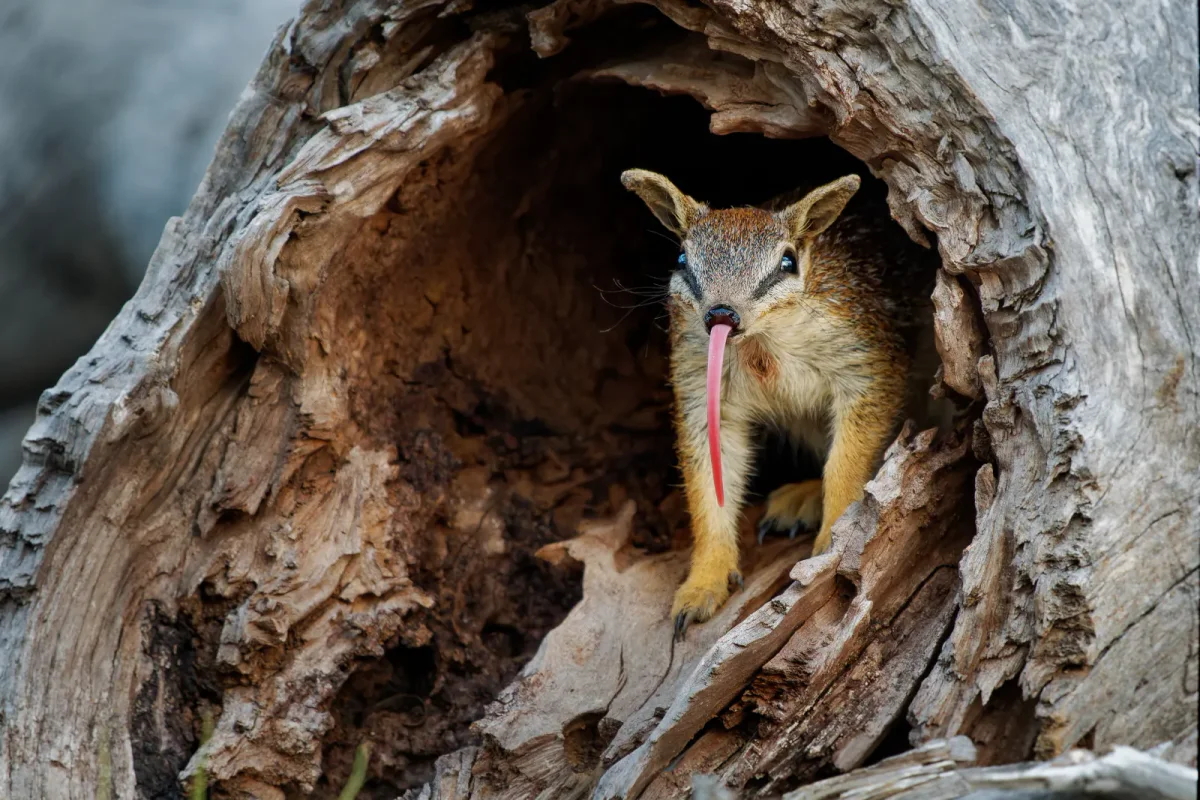
The numbat, also called the banded anteater, is a small striped marsupial from Australia that eats almost nothing but termites. It is about the size of a large rat, with a reddish brown back crossed by white stripes, a dark line through each eye, a pointed snout and a long bushy tail that it often holds upright. Unlike most Australian mammals, it is active during the day, because that is when the termites it eats are moving through shallow tunnels just under the soil. A numbat can eat up to 20,000 termites a day, licking them up with a sticky tongue about 10 centimeters long, almost half the length of its body. It lives in eucalyptus woodland with plenty of fallen hollow logs, where it shelters at night and escapes from predators. Females have no true pouch: their young cling to the teats, protected only by hair. Numbats once lived across much of southern Australia, from Western Australia to New South Wales, but foxes, feral cats and land clearing wiped them out almost everywhere. By the late 1970s fewer than 1,000 survived, in two woodlands of Western Australia. Fox control, breeding at Perth Zoo and releases into fenced sanctuaries have brought them back to more sites. In 2026 the IUCN moved the numbat from Endangered to Near Threatened, with 2,000 to 3,000 adults and a stable population, although Australia still lists it as Endangered.
What Is a Numbat?
The numbat is a marsupial, a mammal whose young are born very small and finish growing attached to their mother's teats. It is the only living member of its family, Myrmecobiidae, and its scientific name, Myrmecobius fasciatus, means banded ant eater. That is also one of its English names, the banded anteater, although it is not related to the anteaters of South America. The two simply evolved in a similar way on different continents: both have a long snout, a long sticky tongue and strong front claws, because both live on ants or termites. Among Australian mammals the numbat stands out for two reasons. It is one of the very few that eat almost nothing but termites, and it is the only marsupial that is active entirely during the day. Its name comes from the Noongar language of southwestern Australia, and in the deserts of central Australia it was known by the Pitjantjatjara name walpurti, from the time when it still lived there. Numbats are shy and quiet animals that weigh less than a kilogram, and they spend most of the day walking slowly through the woodland with their nose to the ground, stopping to dig at the soil wherever they smell termites.
Numbat Size and Appearance
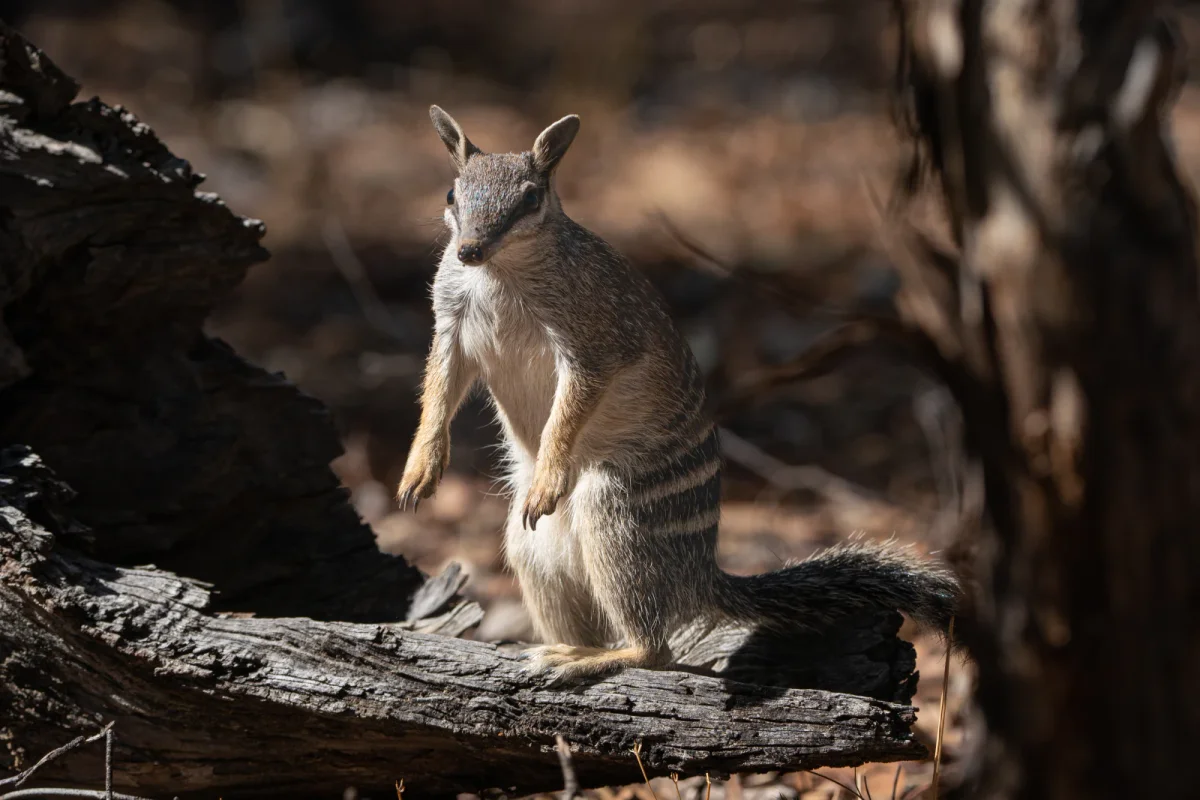
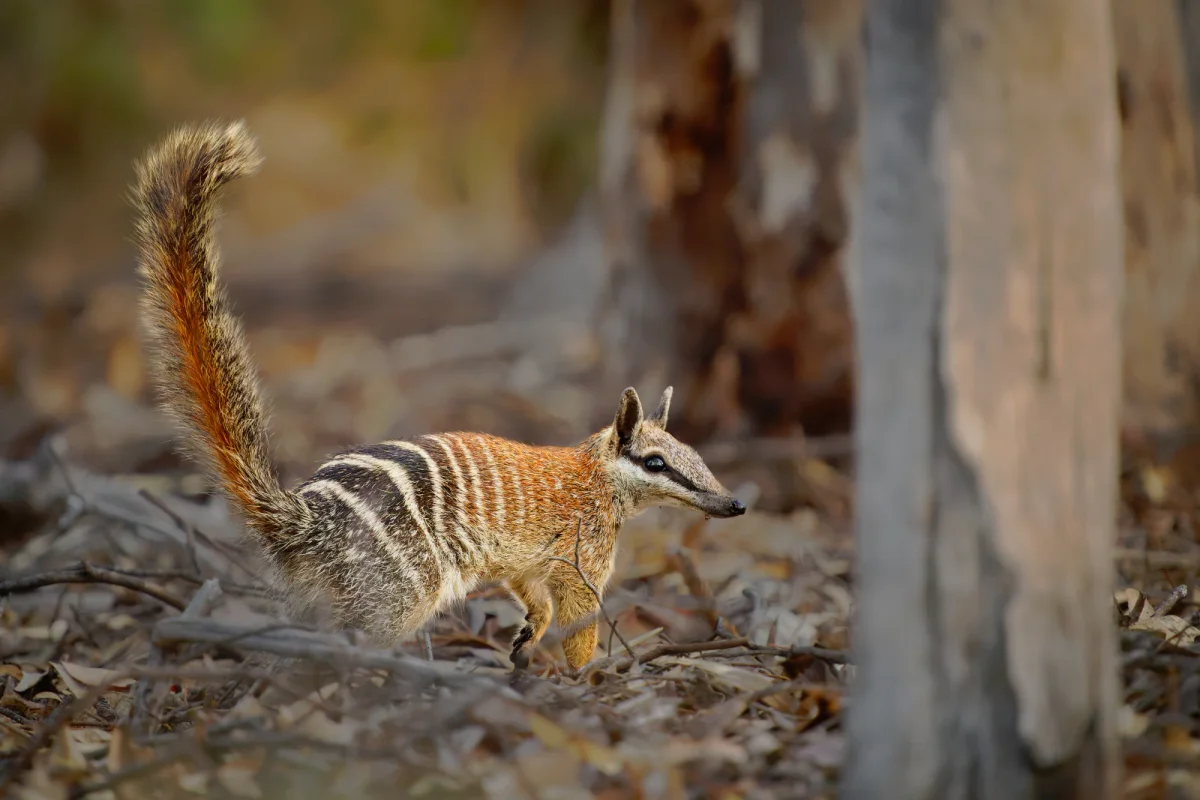
The numbat is a small animal, about the size of a large rat or a small squirrel. Its head and body measure 20 to 29 centimeters, and its long, bushy tail adds a good part of that length again. Adults weigh about 300 to 750 grams, and males are a little larger than females. The coat is one of the most beautiful of any Australian mammal. The front of the body is grayish brown to reddish brown, and toward the back it becomes darker, crossed by four to eleven white stripes that run over the rump. A black line, edged with white, runs from the tip of the snout through each eye to the ears, which are short and pointed. The belly is pale cream. The tail is long and fluffy, grizzled gray and brown, and the numbat often carries it raised, fluffing it up when it is alarmed. The snout is long and thin, and the front feet have five toes with strong claws for scratching open the soil. The stripes help the numbat blend into the patchy light and shadow of the woodland floor, where its main danger comes from above, from hawks and eagles. Even with its bright colors, a numbat that stands still beside a log can be surprisingly hard to see.
Numbat Habitat and Range
The numbat lives only in Australia. When Europeans arrived it was found across a wide belt of the south of the continent, from the southwest of Western Australia through the arid center and South Australia to western New South Wales. After the arrival of the red fox and the spread of feral cats it disappeared from almost all of that area, and by the late 1970s only two natural populations were left, both in the southwest of Western Australia: Dryandra Woodland, east of Perth, and the forests of Perup and the Upper Warren, near Manjimup. Those two places are still its stronghold. Dryandra, now a national park, is the best place in the world to see a wild numbat, especially in spring, when the animals are busy feeding during the day. Since the 1980s numbats have also been released into other parts of Western Australia and into fenced, predator free sanctuaries in other states, such as Yookamurra in South Australia and Scotia and Mallee Cliffs National Park in New South Wales. In all these places the numbat needs the same things: open eucalyptus woodland, often wandoo or jarrah, with plenty of termites and many fallen hollow logs. The logs are its shelter at night and its escape route when a hawk or a fox appears.
Numbat Diet
The numbat eats almost only termites. Now and then it swallows an ant or another small insect by accident, but termites make up nearly its whole diet, and an adult can eat up to 20,000 of them in a single day. To find them it walks slowly with its nose close to the ground, sniffing for the termites that move through shallow tunnels just below the surface. When it finds a spot, it scratches the soil open with its strong front claws and pushes in its long, thin tongue, about 10 centimeters long and covered in sticky saliva, to lick the termites up. Unlike the anteaters of South America, the numbat is not strong enough to break open the hard termite mounds. It depends on finding termites near the surface, and that is the reason it is active during the day. Termites move through their shallow tunnels when the soil is warm, so the numbat's day follows the temperature. In summer it feeds in the morning and late afternoon and rests through the hottest hours, while in winter it comes out later and feeds around the middle of the day, when the sun has warmed the ground.
Numbat Behavior and Young
Numbats live alone for most of the year. Each adult keeps a territory of its own, large for such a small animal, and it spends the day moving through it in search of termites. At night and during the hottest or coldest hours it shelters in a hollow log, a hollow in a tree or a burrow it digs itself, and it often keeps several of these refuges around its territory. Hollow logs are so important that a numbat rarely moves far from one, and when it is frightened it runs for the nearest log and disappears inside. The only time adults seek each other out is the breeding season, in the late Australian summer. Males then travel widely outside their usual area looking for females. A female gives birth to a litter of up to four tiny young, and they stay attached to her teats for about six months while she carries on feeding. Around midwinter, when they have grown too big to carry, she leaves them in a nest in a burrow and comes back to nurse them. In spring the young begin to come out and forage near the nest, and by the start of the next summer, at about a year old, they are independent and leave to find a territory of their own.
Numbat Population and Conservation Status
The numbat is one of the great success stories of Australian conservation. By the late 1970s fewer than 1,000 were left, in just two woodlands of Western Australia, and the species had vanished from every other state. The main cause was the red fox, brought to Australia in the nineteenth century, helped by feral cats, the clearing of woodland for farms and fire. In the late 1980s and 1990s scientists showed that controlling foxes with poison baits made numbat numbers rise again, and baiting became routine at Dryandra, Perup and other sites. Perth Zoo started a breeding program, and since the 1990s more than 300 numbats born there have been released into the wild. Conservation groups such as the Australian Wildlife Conservancy built fenced sanctuaries free of foxes and cats, where numbats now breed in South Australia and New South Wales for the first time in decades. Thanks to all this work, in 2026 the IUCN moved the numbat from Endangered to Near Threatened. Its latest assessment counts 2,000 to 3,000 adults, a stable population and between nine and eleven separate locations. The numbat is not safe yet: cats remain a serious problem, droughts have caused sharp falls in the sanctuaries, and under Australian law it is still listed as Endangered.